
Are Germans Rude or Friendly?
Germany can feel surprisingly cold in brief everyday encounters — yet much warmer and more supportive in other parts of life. Here’s how to tell reserved from rude, respond when needed, and stop one bad encounter from defining your view of the country.
Are Germans really unfriendly — or can Germany just feel that way?
Maybe you are wondering what people will be like before you move here.
Or maybe you already know the feeling: a cashier seems irritated by a normal question, a receptionist acts as if you should already understand the system, or a train employee answers as if you have personally ruined their day.
One encounter is easy to shrug off. Repeated often enough, the question can change from Was that person rude? to Why are people here like this? — And sometimes:
- Is it me?
- Is it my German?
- Is it because I’m foreign?
- Will I ever feel at home here?
If that sounds familiar, one fact is worth knowing right away: Germans notice much of the same roughness.
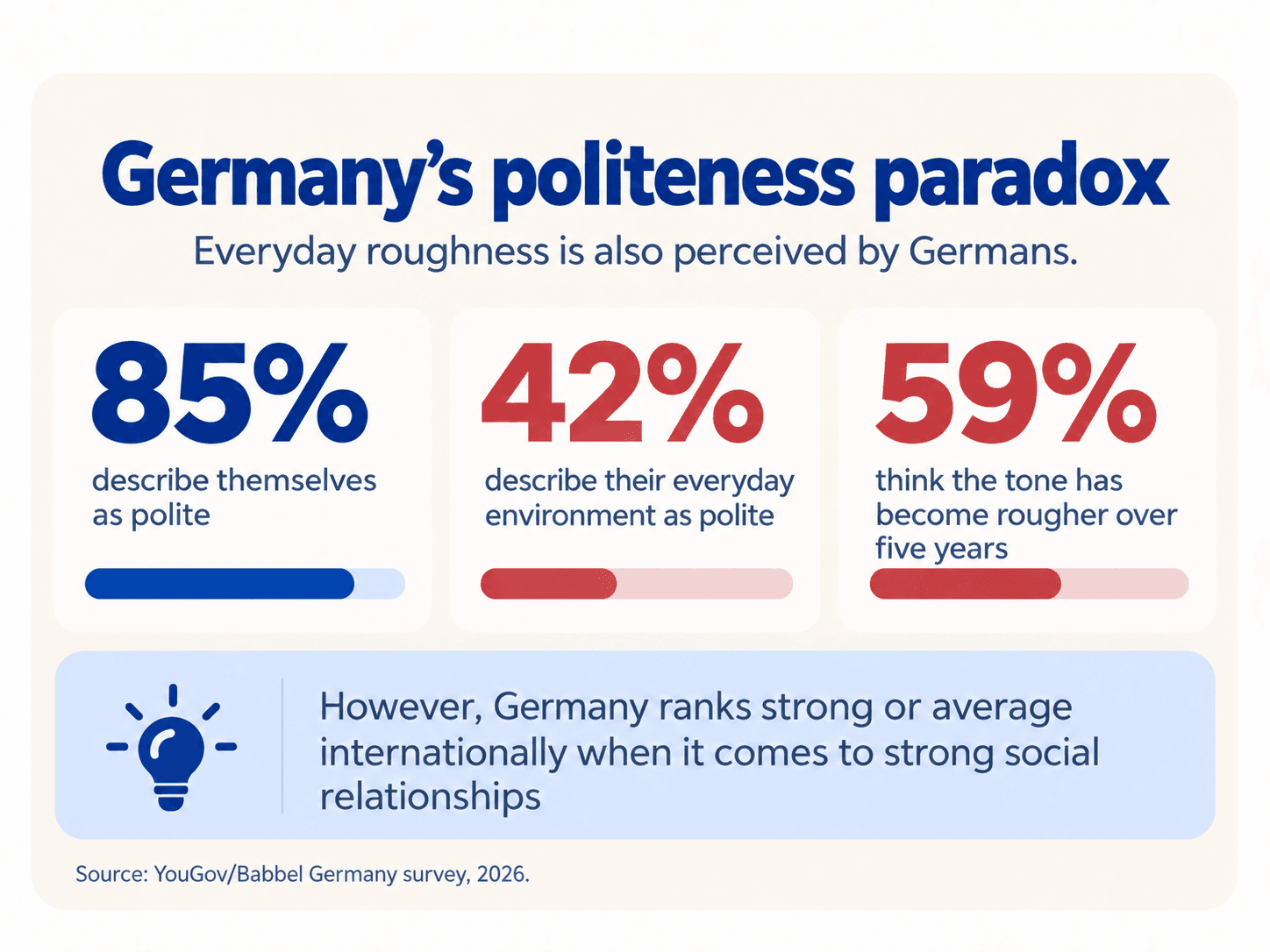
In a representative 2026 survey, 85% of Germans described themselves as polite, while only 42% described the people around them as generally polite. 59% felt that the tone of everyday interaction had become rougher over the previous five years.
The same survey found that many Germans regularly perceive rude behavior in road traffic, stations and restaurants. So an unpleasant interaction does not automatically mean: I failed to understand German culture.
But one rude encounter also cannot tell you why somebody behaved badly. The useful questions are:
- What actually happened?
- Did it cross a line?
- What can you do about it — and how much of your day should this person get?
There is another side to the story too.
Germany performs poorly when internationals rate local friendliness and how easy it is to make local connections. But when we look at established social support, close relationships and neighborhood trust, Germany looks much less unusual internationally — and on some measures relatively strong.
That distinction matters: Easy social contact and strong social relationships are not the same thing.
Why can everyday life in Germany feel unfriendly?
One source of confusion is that friendliness and respect aren’t always shown through the same visible signals. Some everyday encounters in Germany contain relatively little:
- smiling
- small talk
- emotional reassurance
- personal conversation
- relationship-building
Qualitative research with migrants in German cities has described some public interactions as highly functional: the exchange may focus mainly on the immediate task rather than creating an additional social connection.
- You ask for directions.
- Someone tells you where to go.
- Conversation finished.
That can feel cold without necessarily being hostile.
Low warmth is not automatically rudeness
Consider a supermarket checkout. The cashier says:
Mit Karte?
By card
No smile. No extra conversation.
I personally experience that as completely normal. After spending time abroad, I enjoy warmer service more than I used to. A smile is nice. But its absence does not make me think: That cashier dislikes me.
The distinction is useful: Something can lack warmth without containing a negative judgment about you. This is a common point of confusion for foreigners regarding the German stare.
The same happens when I ask strangers for directions. In my experience, people usually help — often very efficiently.
- Helpful? Yes.
- Especially warm? Maybe not.
- Rude? Usually not.
Sometimes German politeness is easier to hear than to see
Imagine I am unknowingly blocking a supermarket employee.
I would expect something like:
Entschuldigung, darf ich bitte durch?
Excuse me, may I get through?
The employee doesn’t have to smile for me to find that polite. The wording already contains several signals:
- Entschuldigung
- bitte
- darf ich
That is one reason German interactions can be harder to read when German is not your first language. Research on German requests also shows that German communication is not simply blunt and unmitigated. Speakers use conventional politeness, modal constructions, reasons and other softening devices.
German directness exists — but it does not explain everything
There is comparative evidence that German communication can be more direct or content-oriented in some situations involving complaints, disagreement and feedback. That may include sentences such as:
Das ist falsch.
That is wrong.
Das funktioniert nicht.
That doesn’t work.
Das müssen Sie anders machen.
You need to do that differently.
Personally, I consider all three fairly normal. Someone used to more verbal cushioning may hear them as much harsher. But directness has limits as an explanation.
Directness describes how explicitly something is communicated. It does not automatically explain:
- shouting
- ridicule
- humiliation
- contempt
- treating somebody like an inconvenience for asking a normal question
And that matters because many public discussions about “rude Germans” are not really about blunt honesty. They are about service counters, transport, doctor’s reception, authorities, and strangers.
Germans notice rude behavior in many of the same places
The idea that internationals merely misunderstand German communication becomes harder to sustain when Germans themselves identify similar high-friction environments.
- 61% reported regularly encountering rudeness in road traffic
- 43% at stations
- 35% in gastronomy
- only around 15% at work
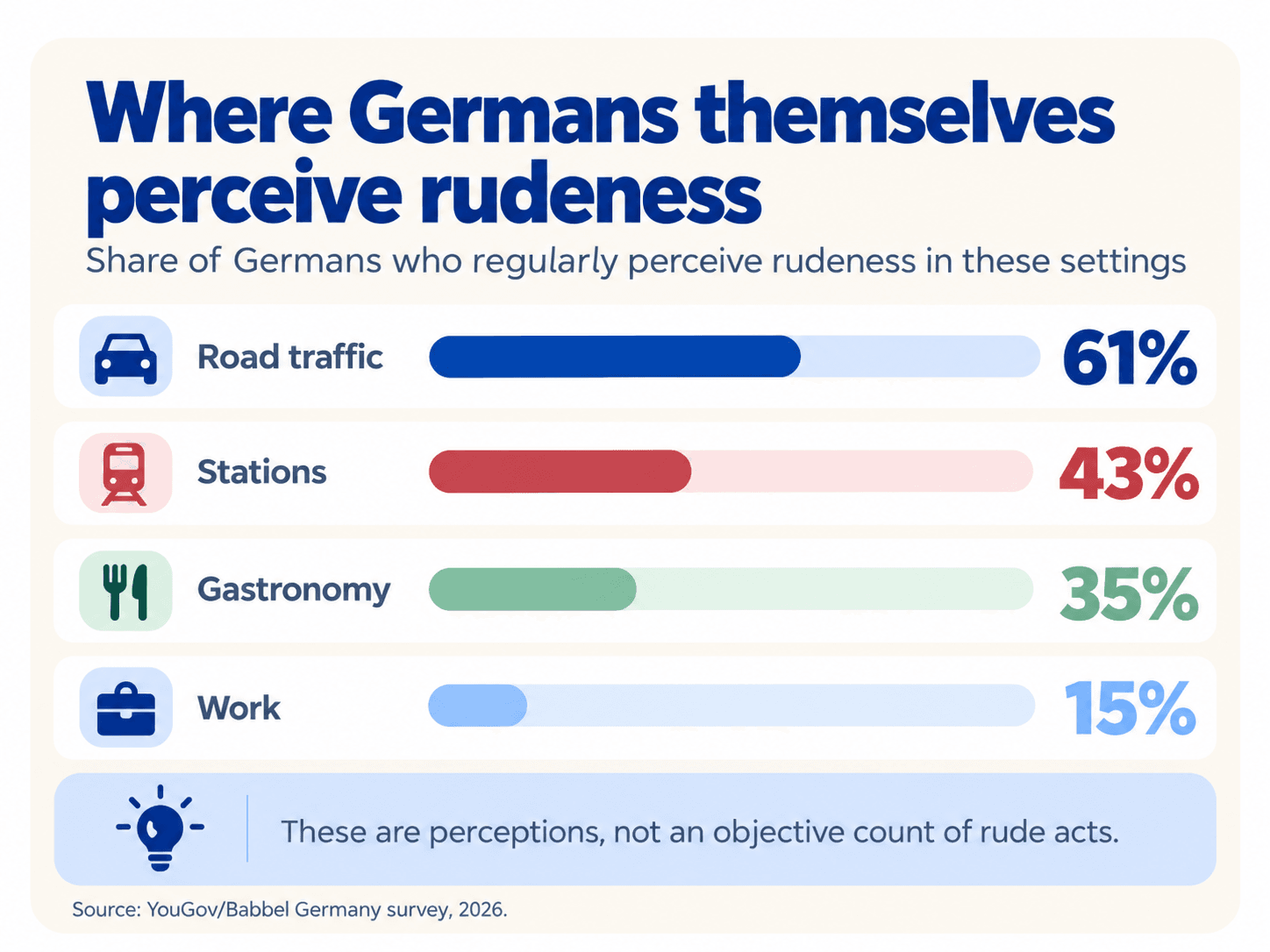
These are perceptions, not an objective count of rude acts. So we cannot say: If you found it rude, a German definitely would too. But we can say: Rough public interaction is not an experience unique to foreigners.
That matters when interpreting motive. One abrupt employee does not tell you whether the reason was:
- your nationality
- your accent
- stress
- language difficulty
- personality
- an ordinary bad mood
It is also useful to keep the broader social picture in perspective. Germany’s 2023 Social Cohesion Radar concludes that a majority of the German population is very open-minded and would have no problem having people with a very different lifestyle, a different religion, foreigners, or homosexual people as neighbors.
That does not mean prejudice or discrimination do not exist. And it does not tell us why one particular person treated you badly. But it is another reason not to read motive into every ambiguous encounter automatically.
The useful distinction is: One ambiguous interaction is weak evidence about motive. Explicit identity-targeted remarks or repeated differential treatment tell you much more.
Why do service encounters create so much friction?
Retail, transport, government offices, medical reception, and hospitality appear repeatedly in expat discussions. These settings have something in common:
- interactions are short
- roles are clearly defined
- somebody needs something
- efficiency matters
- workers may interact with large numbers of people
- rules or procedures may constrain what can happen
That combination creates plenty of room for friction.
Friendly service exists — but warmth may not always be treated as part of the job
German consumers clearly value polite and helpful service. Germany does not have a fundamentally different definition of what “nice” means.
But some service interactions may emphasize completing the functional task more than creating an additional moment of social warmth. That is a subtler claim than: German service culture does not value friendliness. It does.
The difference may be how much smiling, checking in, emotional reassurance, or personal warmth is expected as part of performing the role.
Frontline work can be rough on the other side too
Workers in several of these sectors report substantial verbal aggression from customers or members of the public. A representative DGUV/forsa survey found reported insults or verbal abuse among workers with frequent external contact in:
- health and social services — 49%
- public administration — 46%
- retail — 36%
- transport and storage — 36%
That tells us something about the environment. It doesn’t explain why one employee was rude to you. A stressed employee can still behave professionally.
A customer who did nothing wrong doesn’t have to accept aggression because someone else was difficult earlier. However, context may explain behavior. It does not automatically excuse it.
Bureaucratic rigidity can feel personal
German administration is often described as rule-bound. But saying that officials have no discretion would be wrong. Research on German street-level administration shows that discretion exists, even within formal systems.
At the same time, procedures, accountability requirements, and internal standards can make an interaction feel highly rigid.
- Sometimes the problem is the process.
- Sometimes it is the communication.
- Sometimes both are bad.
Language can add friction without revealing motive
A recurring theme in community discussions is that interactions sometimes become harder once limited German or English enters the conversation. Possible explanations include:
- additional communication effort
- insecurity speaking English
- time pressure
- ordinary impatience
- personality
- prejudice
General second-language research shows that anxiety and perceived competence can affect willingness to communicate. But that is not enough to diagnose one person’s motives. Language is a possible context factor — not an answer.
Everyday friction in context
The sunny side: where Germany can feel much friendlier
There is another Germany that easily disappears from discussions about rude service. One thing I notice every year is what happens as soon as the weather turns good.
- Parks fill up.
- People sit outside cafés and beer gardens.
- Friends crowd riverbanks and lakes.
- People laugh, talk, barbecue, and stay outside for hours.
That is my observation, not statistical evidence. But it is a useful emotional correction: The irritated stranger behind a counter is not your entire sample of German society.
And once we move from anonymous encounters toward trust, support and repeated contact, the data also become noticeably more positive.
Germany may be harder to enter socially than to belong in once relationships exist
International surveys suggest that the first social steps can feel easier in countries such as Spain or the United States than in Germany.
- Starting conversations may come more naturally.
- People may appear more immediately approachable.
- Newcomers may feel socially at ease faster.
But that should not be confused with the strength of established relationships.
The close-relationship data above show Germany, Spain, and the United States are surprisingly close once we look at social support and intimate ties. The datasets involve different populations and cannot prove a causal progression. But they help separate two questions.
Social entry
How easy is it to:
- Approach people?
- Chat?
- Make first connections?
- Feel socially comfortable quickly?
Established relationships
Once relationships exist:
- Do you have people you can rely on?
- Do you have close friends?
- Do you feel supported?
Clubs and sport can help — if they actually create repeated contact
“Join a sports club” is common expat advice.
But an anonymous gym in a large city, where everyone wears headphones and leaves immediately after training, isn’t what the useful evidence is really about. The social ingredient is: repeated shared activity.
For example:
- Team sport
- Running group
- Climbing with the same group
- Martial-arts classes
- Verein
- Regular group training
- Volunteering
German research links organized sports participation, especially club participation, with social capital. Qualitative research with refugees in German sports clubs also describes friendliness, reciprocity, and belonging.
None of this guarantees friendship. The advantage is simpler: you have a reason to see the same people again.
First impressions can be misleading
I have met people and initially thought: This person is unfriendly.
Then I had to work with them. They turned out to be perfectly nice. That does not prove that Germans “warm up once you know them.” But it is one reason I personally give a first low-warmth interaction relatively little weight.
A reserved first impression does not always tell you much about the person behind it.
Is this reserved, direct, or actually disrespectful?
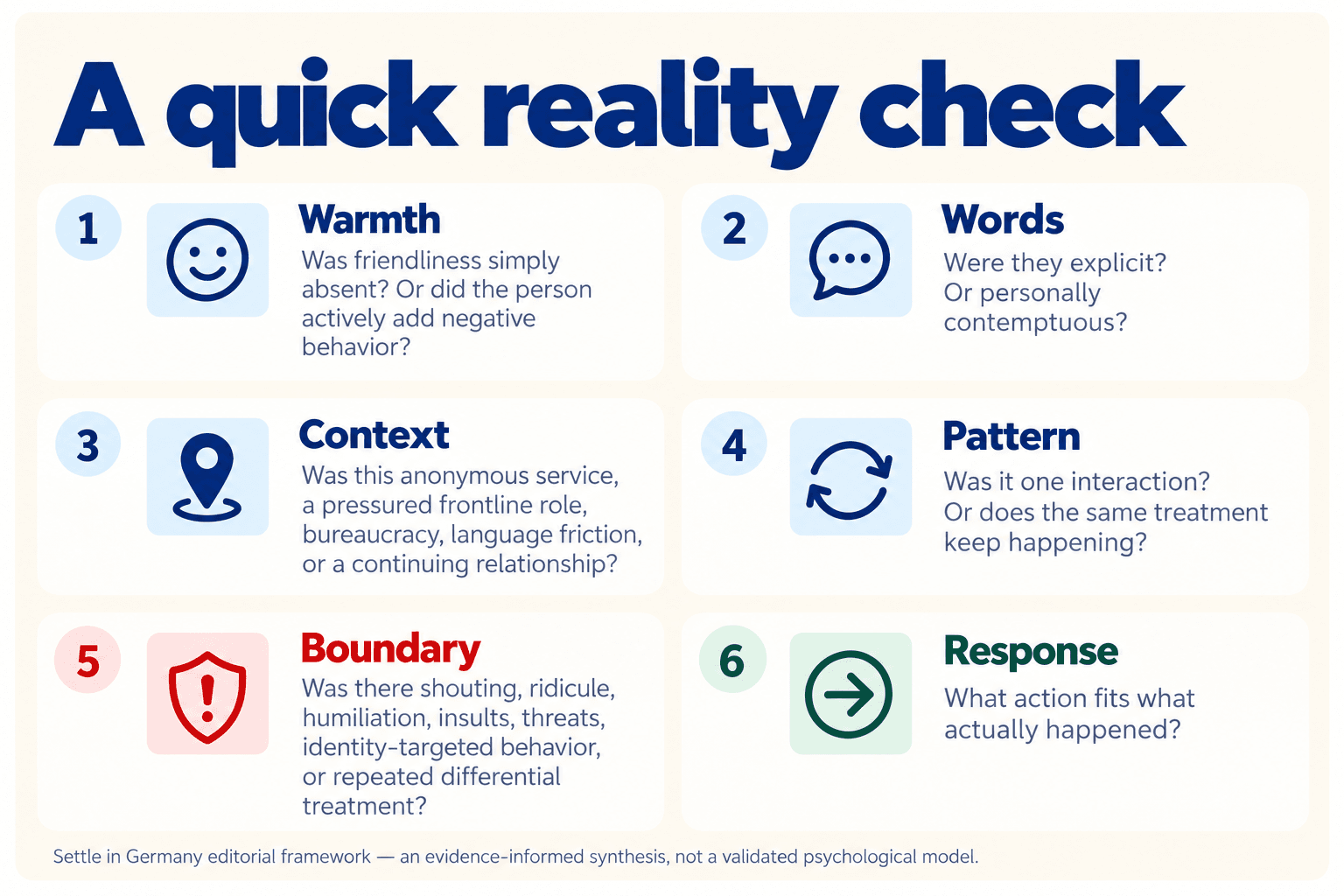
There is no scientifically validated German rudeness test. But the evidence gives us a useful way to think. Settle in Germany has developed the framework below with six building blocks: warmth, words, context, pattern, boundary, and response.
Three useful categories
Reserved / low-warmth: dislike the interaction without assuming hostility; examples:
- no smile
- no small talk
- short factual answer
- practical help followed by immediate disengagement
Direct: It can feel harsh without necessarily being disrespectful; examples:
- blunt correction
- clear refusal
- explicit criticism
- little verbal cushioning
Disrespectful: Searching for a cultural explanation becomes much less useful; examples:
- shouting
- insults
- ridicule
- humiliation
- contempt
- threats
- repeated targeted treatment
What can you do?
Low warmth: Nothing, just conclude that it wasn’t warm but neither about you.
Direct but acceptable: Respond to the content rather than the lack of cushioning.
Ambiguous: Clarify instead of silently guessing motive.
Actually rude: Set a calm boundary (e.g., There’s no reason to speak to me like that. I’m treating you respectfully too.)
Repeated or targeted: Then the interaction deserves more weight depending on the situation (e.g. complain, ask for another employee, change provider, document what happens, seek specialist advice when discrimination may be involved)
When these encounters start getting under your skin
A rude interaction may last two minutes. What matters psychologically is what happens afterward. For a newcomer, one ambiguous encounter can generate questions that I usually do not have to ask myself as a German:
- Was it my German?
- Was it because I’m foreign?
- Did I do something wrong?
- Is everybody here like this?
I already have context. I know which interactions feel normal to me. I know which ones I consider rude. And I have relationships that matter much more to my sense of home than an anonymous person at a counter.
A newcomer may not yet have that same social counterweight. That means coping is partly about one additional question: How much importance does this person deserve in my life?
How to stop one bad encounter from taking over your day
1. Do what is useful — then close the file
Do it if action is useful: say something, complain, change provider, document the incident.
But when there is nothing useful left to do, try not to keep solving an unsolvable interaction in your head. Research on psychological detachment links mentally disengaging from stressors with better recovery and lower exhaustion.
This is not Pretend it didn’t bother you, it is I have done what I can. This person does not get the rest of my afternoon.
2. Look at their side before making yourself the explanation
This mental habit helps me most. When somebody behaves unexpectedly badly, I first consider possibilities on their side.
- Maybe they are stressed.
- Maybe they had a terrible morning.
- Maybe they are sick.
- Maybe they are simply unfriendly.
I often end up thinking something closer to: I feel sorry for them if their day is going like this. than What is wrong with me?
I do not actually know what caused their behavior. That is the point. I do not automatically make myself the explanation.
Research on reappraisal and self-distancing supports the broader idea of stepping back from an immediate self-focused interpretation of stressful events.
3. Ask whether this person matters to your life
A stranger behind a counter usually does not:
- Your friends do.
- Your family does.
- Your partner does.
- People you work with closely may.
- Your community may.
Those relationships deserve far more emotional energy than somebody you may never see again.
This perspective is easier once you already have a social base. If you are new to Germany and do not yet have that base, that is all the more reason to build contexts that give you more positive information about your life here than anonymous service encounters can.
4. Let good encounters count too
One unpleasant interaction can dominate your memory of a day when several other people were neutral, helpful, or genuinely kind. So let that interaction register when somebody:
- patiently explains something
- smiles at you
- goes out of their way to help
- walks you to the right platform
- makes a joke
- welcomes you into a group
Psychologists use the term savoring for deliberately attending to and extending positive experiences. This is not about pretending Germany is friendlier than it feels. It is about not letting negative evidence take up all your attention.
And when somebody goes beyond what they had to do, you do not need to turn it into another theory about your new home Germany. It can be enough to think: That person chose to be kind to me.
5. Protect the people who make you feel accepted
Your support network does not need to be German.
- Call your friend back home.
- See another international.
- Spend time with your partner.
- Meet the German colleague, neighbor, or friend you genuinely like.
The point is not to integrate harder but to not let anonymous public encounters become your entire social sample of Germany.
Research across migrant populations consistently finds social connectedness strongly associated with better adaptation.
And there is a simple practical effect too: The more relationships you have that make you feel secure and accepted, the less authority one irritated stranger has over your sense of belonging.
6. Build places where people can recognize you
Instead of maximizing the number of strangers you meet, create situations where some people stop being strangers. That could be:
- a sports team
- a Verein
- a recurring course
- volunteering
- a hobby group
- the same café
- the same weekly meetup
- regular neighborhood routines
The important feature is not to meet everyone, but to see some of the same people again. That creates the conditions for recognition, familiarity, and, eventually, relationships to develop. It doesn’t guarantee friendship, but it gives you a place to start connecting.
7. Do something you genuinely enjoy
Do not let “dealing with Germany” become the rest of your evening.
- Cook.
- Read.
- Play a game.
- Go outside.
- Work on something you care about.
- Watch something you enjoy.
- See somebody you like.
Research on behavioral activation supports deliberately returning to valued and enjoyable activities as a general wellbeing strategy. Sometimes the best response to an unpleasant stranger is simply to have a good evening anyway.
8. Move your body without making it an integration task
Exercise does not always need a social objective: run, cycle, walk, swim, go to the gym.
If you want connection as well, choose a recurring group activity. If you do not, movement can still simply be recovery.
The point is that taking care of yourself doesn’t always have to become another project called finding your place here. Sometimes you just need to feel good about yourself again.
Still wondering if a behavior was rude or German?
Tell the Culture Decoder what happened. We’ll help you work out how much German culture actually explains it — and whether it was more personal or just rude.
So, are Germans rude or friendly?
Neither label captures the interesting part. Germany can feel low-warmth in anonymous public encounters.
- Some service settings genuinely produce a lot of frustration, and Germans themselves report substantial everyday roughness.
- German communication can also be more direct in certain situations.
- Sometimes a person is simply rude.
But look beyond anonymous interactions and the picture changes.
- Neighborhood trust is high compared with other countries.
- Germany’s levels of established social support and close personal relationships are similar to those in Spain and the United States.
- The overwhelming majority of international students report feeling welcome at their universities.
- Private contact between people with and without migration backgrounds is common.
Repeated, shared-purpose settings such as work, clubs and sports give relationships something a service counter does not: context and continuity.
So perhaps the most useful contrast is not rude Germans vs friendly Germans but anonymous encounters vs relationships that actually have context, continuity and meaning.
You will not always know why somebody behaved badly. You need to know:
- what happened
- whether it crossed your boundary
- what useful action remains
- and whether this person deserves any more space in your day
Fortunately, you do not need perfect insight into their mind.
How we researched this article
We reviewed several different kinds of evidence for this article: peer-reviewed research on communication, migration, and social connection; official and public data; representative surveys from Germany; international surveys; and current discussions among people living in Germany.
We used community discussions differently from scientific or representative data. They helped us identify recurring situations, the language people use to describe them, emotional pain points, competing explanations and important counterexamples. We did not use Reddit, forums or social media to estimate how common an experience is among internationals or Germans. We also include a first-hand perspective, where it adds useful context. Those observations are presented as personal experience, not as evidence about Germans in general.
What we did not find: An important limitation is that the sources do not all measure the same thing. Neighborhood trust, social support, feeling welcome at university, expats’ ratings of local friendliness and perceptions of politeness are different measures based on different populations. We therefore use them side by side to illuminate different parts of the picture — not to create a single “German friendliness” score.
We also did not find a matched-vignette study testing whether Germans and internationals judge the exact same rude-feeling everyday interactions differently. And neither research nor a cultural framework can reliably tell us why one particular person behaved the way they did. That is why this article separates established evidence, plausible interpretations, community signals and personal observation — and treats individual motives as uncertain unless the situation provides much clearer evidence.
See all sources
- Babbel (2026): Unhöflichkeit in Deutschland nimmt zu
- Deutsche Gesetzliche Unfallversicherung (2025): Im Job beleidigt
- Runst, P. (2021): A case study of bureaucratic discretion
- Ackermann, T. (2023): Mitigating strategies and politeness in German requests
- Elahi et al. (2019): A Meta-analysis of L2 Willingness to Communicate and Its Three High-Evidence Correlates
- Duden et al. (2026): Inside-Out
- House, J. (2006): Communicative styles in English and German
- Our World in Data (2020). Share of people who trust others in their neighborhood
- Ritchie-Dunham et al. (2025): Demographic variation in social support and intimate friend across 22 countrie
- Statistisches Bundesamt (n.d.): Beziehung zu Kollegen und Vorgesetzten
- Deutsches Zentrum für Integrations- und Migrationsforschung. (n.d.): Integration im Faktencheck
- Burrmann et al. (2019): Playing together or bowling alone
- Fast et al. (2025): Zugehörigkeitserfahrungen jugendlicher Geflüchteter in Sportvereinen
- Bierwiaczonek et al. (2025): A Meta-Analysis of Social and Contextual Correlates of Migrant Adaptation to Living in Receiving Societies
- Deutscher Akademischer Austauschdienst (2025): Deutschland bevorzugtes Ziel für internationale Studierende
- Boehnke et al. (2024): Gesellschaftlicher Zusammenhalt in Deutschland 2023
- InterNations (2026): Solid work & stubborn bureaucracy in Germany in 2026
- InterNations (2026): Where expats feel welcome in 2026
- InterNations (2026): A short survey methodology
- Stover et al. (2024): A meta-analysis of cognitive reappraisal and personal resilience
- Murdoch et al. (2023): The effectiveness of self-distanced versus self-immersed reflections among adults
- Chen et al. (2026): Effectiveness of savoring interventions
- Wendsche et al. (2017): A Meta-Analysis on Antecedents and Outcomes of Detachment from Work
- Mazzucchelli et al. (2010): Behavioral activation interventions for well-being
