
German Workplace
Culture
Working in Germany can be direct, autonomous, flexible, and supportive. But many of the day-to-day differences you experience may come from your employer, team, role, and work environment rather than from “German culture” alone.
What German workplace culture is actually like
If you are preparing for a job in Germany, you will quickly come across familiar descriptions: Germans are direct, punctual, hierarchical, efficient, formal, and serious about separating work from private life.
Some of those ideas contain a piece of reality. Taken together, however, they create a much more uniform picture than the evidence supports.
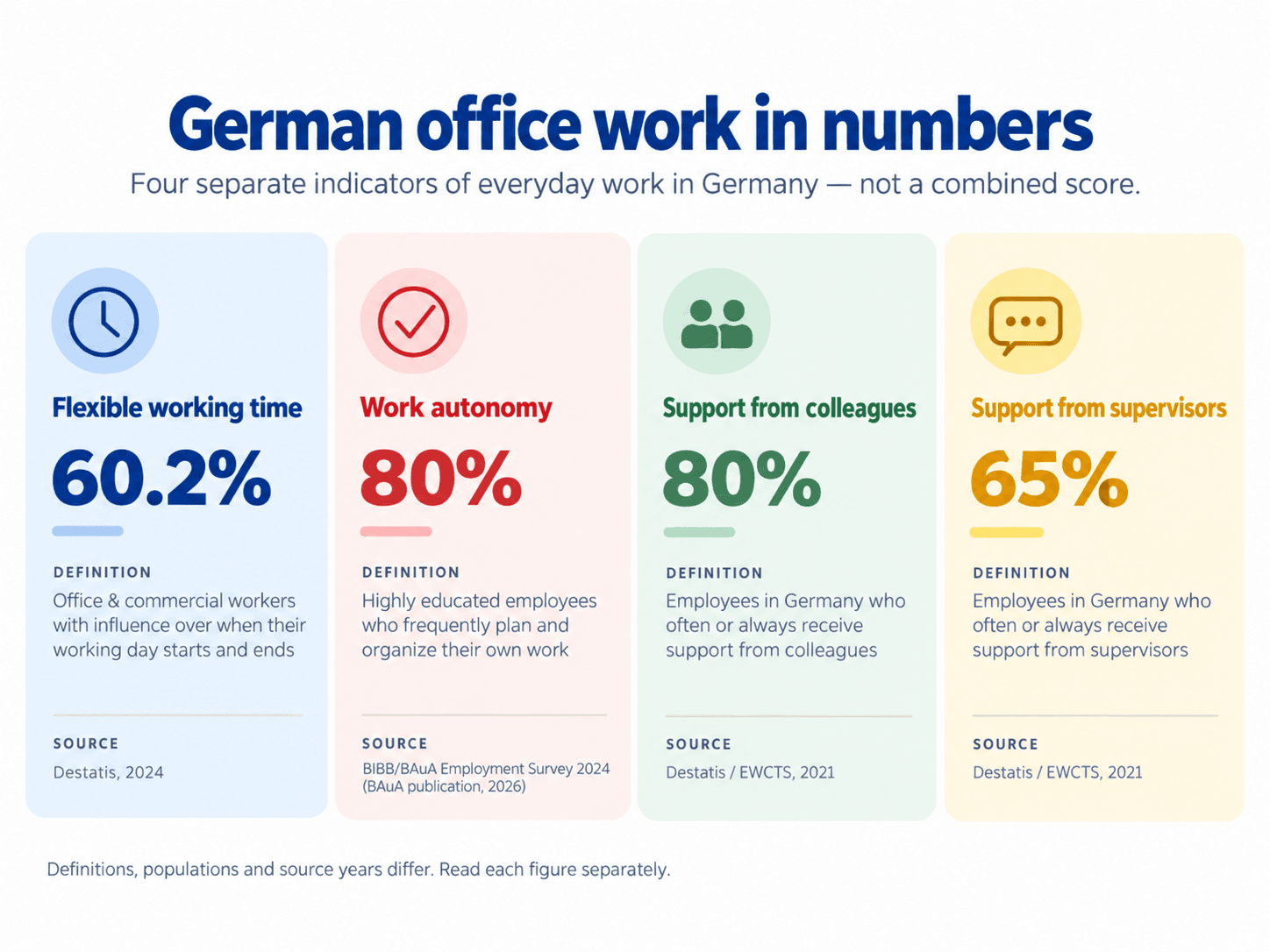
For qualified office and knowledge workers, German working life can be highly autonomous and flexible. According to Destatis data on flexible working hours, 60.2% of office and commercial workers had some influence over when their working day started and ended in 2024. Among scientific occupations, it was 67.3%, and among managers, 84.2%.
Autonomy is also common in qualified work. BAuA’s 2026 overview of the German working world, drawing on the representative BIBB/BAuA Employment Survey 2024, reports that 80% of highly educated employees frequently plan and organize their own work, compared with 61% among employees with medium education and 40% among those with low education.
Supportive working relationships are common, too. Destatis working-conditions data on relationships with colleagues and supervisors show that 80% of employees reported often or always receiving support from colleagues and 65% from supervisors.
So the most useful question is not simply: What are German workplaces like? It is:
Which parts of what I am experiencing are actually related to Germany — and which come from this company, this team, my role, the language situation, or one individual?
That distinction matters because two employers in Germany can offer radically different working environments.
This guide focuses primarily on international professionals in office, tech, engineering, research, and other knowledge-work environments. Other workplaces — from hospitals to workshops and customer-facing roles — may operate very differently.
Which parts of German work culture are actually supported by evidence?
German communication can be more direct — but direct does not mean rude
This is one of the clearer cultural differences in the research we reviewed.
In a workplace communication study comparing German and Australian telephone conversations, German speakers were more willing to voice negative assessments rather than avoid them. Other cross-cultural pragmatics research similarly points to differences in how German and English-speaking participants handle potentially face-threatening communication.
That can make a perfectly work-focused sentence sound unexpectedly sharp to someone accustomed to more cushioning.
For example: This presentation is too long. Cut the middle section.
may feel very different from: This is already interesting. Maybe we could tighten the middle section a little.
But nationality is only one possible explanation for blunt wording.
Time pressure may shorten communication. A particular manager may simply communicate badly. A team may have developed unusually terse habits. And once criticism becomes humiliation, personal attacks, or repeated disrespect, “German directness” no longer explains it. Read more about rude communication in Germany here.
German workplaces can have clear hierarchy and still expect you to speak up
Asking whether Germany is “hierarchical” often hides several different questions.
- Who makes the final decision?
- Who may challenge it?
- How independently are employees expected to work?
- How much formal employee voice exists?
Germany has clear organizational hierarchies, but also extensive institutional employee representation. According to 2025 IAB data on collective bargaining and employee representation, 84% of employees in establishments with 201 or more employees work in workplaces with a works council or staff council.
So hierarchy does not necessarily mean that employees are expected to remain silent. Having a voice is not the same as having final authority.
A manager can genuinely ask for your view, value the contribution, and still decide on a different course. That does not automatically mean your input was ignored. In many workplaces, the expected sequence is closer to: Raise the objection clearly, explain your reasoning, let the decision owner decide, then move forward.
Repeatedly reopening the same argument after the decision may be perceived differently than contributing strongly before the decision.
Independence usually means owning your work — not deciding everything yourself
German workplace autonomy can confuse newcomers because several expectations can exist at once.
You may be expected to organize your own tasks, manage your time, identify problems independently, and propose solutions. But you may still need approval for decisions involving budgets, deadlines, other departments, clients, technical risk, or strategic direction.
Own your work. Check your authority. Someone who needs detailed instructions for every small step may eventually appear insufficiently independent.
At the same time, particularly during onboarding, asking before making a consequential decision is often more sensible than confidently exceeding your responsibility.
Reliability also means saying early when something will not work
“Germans are reliable” is not a very useful workplace instruction.
Take commitments seriously — and communicate early when a commitment is becoming unrealistic.
Practical guidance for internationals working in Germany recommends informing colleagues early if a deadline cannot be met rather than waiting until the deadline itself. So reliability does not have to mean hiding difficulty. It can mean saying early:
I won’t finish this by Thursday with the current scope. We either need to reduce the scope or move the deadline.
Good workplace design also matters here. BAuA guidance on social relationships at work recommends environments where employees receive support, feedback, and recognition, and where conflicts and mistakes can be discussed openly.
That does not mean every German workplace provides enough psychological safety to do this comfortably. Treat early problem communication as a useful workplace expectation — not as proof that every employer reacts well when somebody speaks up.
Feedback and appreciation are not absent from German workplaces
The familiar claim that “German bosses don’t praise” is too crude. Research distinguishes between feedback, appreciation and explicit verbal praise. They are not interchangeable.
A 2026 Germany–US study of employee appreciation found German respondents reporting more appreciation from supervisors and colleagues than their US counterparts. At the same time, current BAuA reporting on social relationships and recognition suggests that frequent explicit praise from a direct supervisor is far from universal, at around 41%.
So Germans neither praise constantly nor avoid praise alltogether. The form and frequency of positive feedback vary considerably — and absence of enthusiastic verbal praise does not by itself tell you whether your work is valued.
Planning and quality can sometimes win over “just try it”
Another familiar experience is the clash between careful planning and rapid experimentation.
Imagine a software project where development keeps getting postponed as more requirements are added, more edge cases are considered, and the desired final solution grows increasingly complex.
One person may ask: Why don’t we build a simple version and test it? Another may prefer to reduce uncertainty before implementation begins.
GLOBE-based research on German leadership and organizational culture has historically pointed to relatively high uncertainty avoidance in German management samples, while qualitative research on entrepreneurship in Germany has identified perfectionism and uncertainty management as potentially relevant mechanisms. But this should remain a qualified interpretation.
The same behavior can also come from regulation, industry risk, company age, internal politics, or poor project management. Hence, some German organizations can feel highly planning-oriented.
“German efficiency” is a weaker cultural claim than it sounds
Economic productivity is not a personality test.
Output per hour depends on technology, capital, organization, industry mix, and many other factors. It does not prove that German employees are culturally “efficient.”
Likewise, punctuality is widely discussed as an expectation in German professional life, but we should be careful not to turn that into an unsupported claim that Germans are objectively more punctual than other nationalities.
Common claims we would not present as established facts
- German bosses rarely praise.
- German workplaces are highly hierarchical.
- Germans never socialize with coworkers.
- German workers are naturally more efficient.
- Germans are always more punctual than other nationalities.
- German corporates are inherently political and indecisive.
- Mittelstand managers have poor people skills.
People may genuinely experience any of these things. The problem begins when one experience is turned into a national rule.
Why one German workplace can feel nothing like another
German employers themselves report very different management environments.
In the 2026 Randstad-ifo HR survey, 68% described their management culture as family- or team-oriented and cooperative, 18% as results- and performance-oriented and competitive, and 8% as process-oriented, structured and formal. Smaller groups chose participative or innovative/agile cultures.
The same survey asked employers about relations between management and employees:
- 43% described them as open and trusting.
- 37% described them as friendly.
- 16% described them as factual or task-oriented.
- 4% described them as distant and hierarchical.
These are employer and HR self-descriptions, not independent employee ratings. That limitation matters. But the results still demonstrate something useful:
German employers don’t even describe themselves as having a single common management culture.
Company size also changes some of these patterns. Large employers in the same survey were more likely to describe management relations as factual or friendly and less likely to call them open and trusting.
| Dimension | Startups | Smaller firms / Mittelstand | Large companies |
|---|---|---|---|
| International workforce | Often high in startup data | Lower on average in firm-size data | Foreign skilled workers substantially more common |
| English working environment | Particularly common in international startup hubs | More German-language-dependent on average | Common in many international functions |
| Remote work | Very high in current startup-sector data | Strong variation | Strong variation |
| Digitalization | Generally high in startup surveys | Clear size gap within Mittelstand | Greater organizational resources, but often more formal systems |
| Works councils / formal employee representation | Limited by small company size | Lower on average | Much more common |
| Formal training infrastructure | Often less institutionalized | Lower on average | Much more widespread |
According to 2026 German Startup Association data on remote work, the remote-work share in startups was 61%, compared with 32% in the established economy.
Larger firms are also substantially more likely to employ foreign skilled workers. A 2025 ifo survey on hiring and foreign skilled workers found that 87% of companies with 500 or more employees employed foreign skilled workers, compared with 51% of firms with up to 49 employees.
Formal training infrastructure also rises sharply with company size. Destatis reporting from Germany’s Continuing Vocational Training Survey shows that 69.4% of companies with 10–19 employees offered continuing training, compared with 95.6% of companies with 1,000 or more employees.
The table does not mean every startup is modern, every Mittelstand company is conservative, or every corporation is bureaucratic. Those are exactly the generalizations we want to avoid. A better way to use the categories is as context:
- A startup may combine English, remote work, and high autonomy.
- A small owner-managed company may operate mostly in German and concentrate important decisions in a few people.
- A multinational corporation may have far more formal consultation, reporting, and coordination.
- Another company in the same category may look completely different.
What this can look like in real workplace situations
Your manager asks for your opinion — and decides differently
That can be completely compatible with genuine employee participation.
The useful distinction is between contributing to a decision and owning it. Your input may alter the discussion without determining the final outcome. Before interpreting the situation as hierarchy or disrespect, ask:
- Was my argument heard?
- Was there a reason for the decision?
- Who actually carries responsibility for the outcome?
A colleague suddenly sounds much harsher under pressure
Direct communication is one possible explanation. Time pressure is another.
One short interaction usually does not reveal whether the cause is culture, personality, stress, or hostility. Look at the wider pattern:
- Does the person communicate respectfully under normal conditions?
- Does the behavior disappear once the pressure is off?
- Or are criticism and disrespect persistent?
You are expected to work independently — but still need approval
This is not necessarily contradictory. You may have complete control over how you carry out the work while lacking authority to change its budget, deadline, or strategic direction.
Independence and decision power are different dimensions.
Your team keeps planning instead of shipping
The same frustrating behavior can have cultural, organizational, or simply project-management explanations. Before turning this into a Germany story, check the context.
- Is failure expensive?
- Is the industry heavily regulated?
- Are several departments involved?
- Does management fear mistakes?
- Is the project genuinely over-engineered?
Your English-speaking team switches to German
An official English working language does not mean every interaction will actually happen in English.
Research based on 90 interviews in 15 multinational teams across three German automotive corporations found that language barriers could influence trust formation. Later research on language barriers and knowledge processing in multinational teams found that language differences can also reduce participation and impede the processing and sharing of knowledge.
In public discussions we reviewed, international employees also repeatedly described teams switching to German during side discussions, intense conversations or informal moments.
The switch may not be hostile. But intention and impact are different questions:
- Brief functional switching: A short German exchange happens, and the relevant content is brought back into English.
- Social exclusion: Meetings are in English, but lunch, small talk, and informal bonding repeatedly happen in German.
- Work-critical exclusion: Decisions, knowledge or important context repeatedly remain inaccessible to a team member.
The third situation deserves a much stronger response than the first.
Your colleagues are friendly — but not your friends
Professional support, team belonging and private friendship are separate things.
High levels of colleague support in German employee surveys don’t tell us how often coworkers become private friends. Nor do we have strong evidence that Germans generally refuse to become friends with colleagues.
Work-private boundaries are better treated as one possible factor among several.
Another is simply social capacity. Two coworkers who have both just moved and are making it their home may have much more reason to meet after work than two people who already have established partners, children, hobbies and long-term friend groups.
Amrop’s 2024 cross-country Meaning of Work study found that 41% of degree-educated German respondents aged 20–60 agreed that their work reflected who they were, compared with 48% in the US. Germany also scored lower on several other career-centrality questions. That could make maintaining non-work identities and relationships particularly meaningful for some people. But it does not prove that Germans socialize less with colleagues.
You can make friends at work in Germany — sometimes gradually, and sometimes even after the shared workplace has ended.
Is this German culture — or something else?
A checklist of German traits becomes much less useful once you are trying to interpret one real situation. The following is a Settle in Germany editorial framework, not a validated scientific diagnostic.
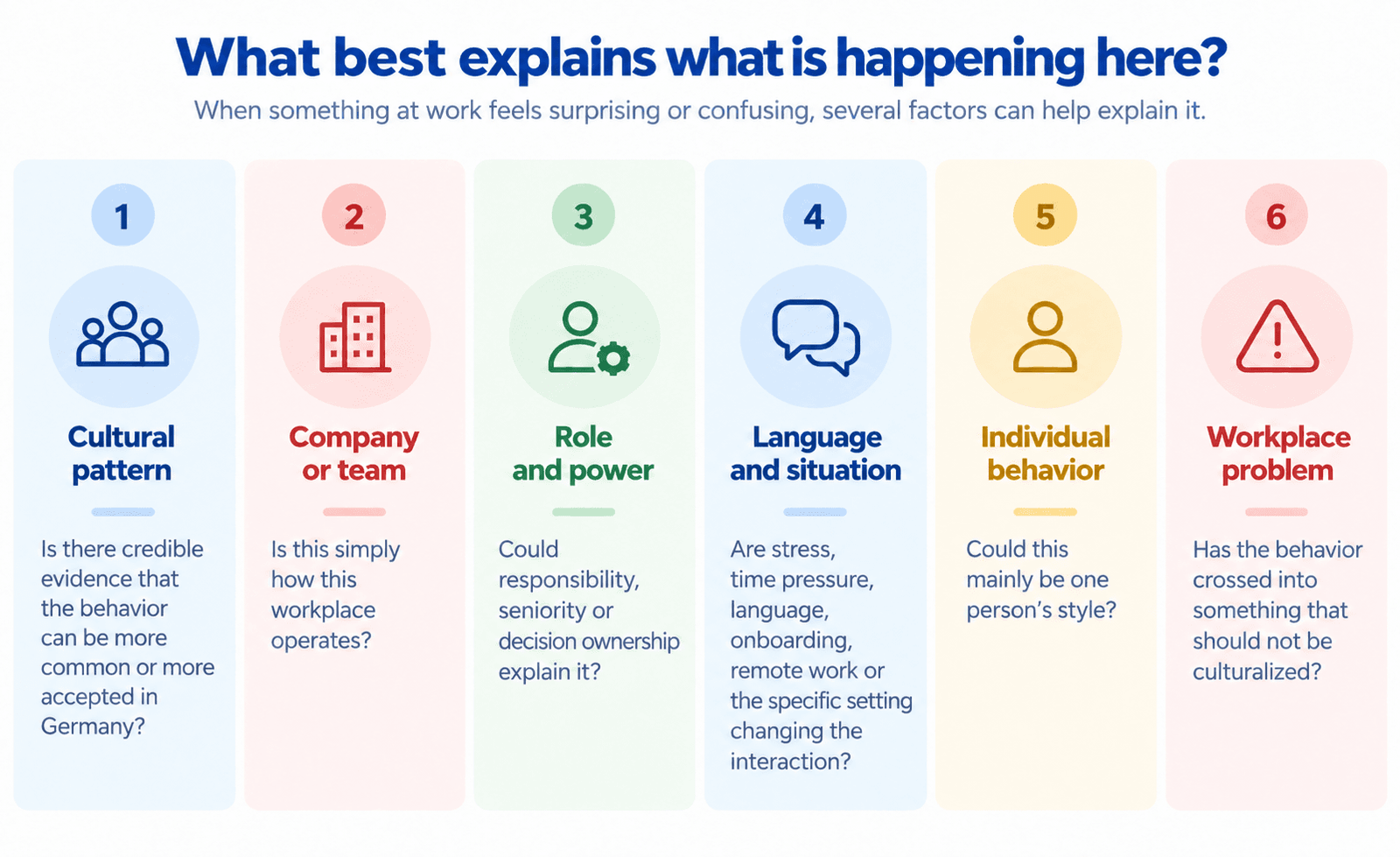
- Cultural pattern: Is there credible evidence that the behavior can be more common or more accepted in Germany?
Example: relatively explicit criticism in some situations. - Company or team: Is this simply how this workplace operates?
Example: one organization may require extensive documentation and approval while another gives teams broad discretion. - Role and power: Could responsibility, seniority or decision ownership explain it?
Example: you may be expected to challenge a proposal even though the manager owns the final decision. - Language and situation: Are stress, time pressure, language, onboarding, remote work or the specific setting changing the interaction?
Example: an English-speaking team shifts into German during an intense side discussion. - Individual behavior: Could this mainly be one person’s style?
Example: a controlling manager is not automatically evidence of German management culture. - Workplace problem: Has the behavior crossed into something that should not be culturalized?
Example: repeated humiliation, bullying, discrimination, harassment, retaliation, deliberate exclusion or systematic withholding of work-relevant information.
Several explanations can be true simultaneously. The purpose is to stop automatically moving to Germans are like this.
Still wondering whether this is normal at work?
Something happened at work and you can’t tell whether it was cultural, personal or a real problem?
Where cultural explanations should stop
Serious workplace problems exist in Germany too.
A representative BMAS study of 5,015 dependent employees found that 6.5% met its definition of workplace bullying during a six-month period. Some 4.4% reported bullying by colleagues and 3.5% by supervisors. These groups overlap.
Discrimination also requires separate attention. A DeZIM analysis of Germany’s 2022 SOEP data found that 21% of people with a migration background reported discrimination during the previous year, compared with 9.8% without a migration background. Among respondents who experienced discrimination, 39.2% named working life as one setting where it occurred. That does not mean 39.2% of employees experience workplace discrimination.
Sexual harassment is another distinct category. A representative study commissioned by Germany’s Federal Anti-Discrimination Agency found that 9% of working people had experienced sexual harassment at work during the previous three years, including 13% of women and 5% of men.
At the same time, German working-conditions data show high reported support from colleagues and supervisors. These measures are not directly comparable, but together they provide an important guardrail:
- Do not make harmful behavior the default explanation for an ambiguous interaction.
- Do not use “German culture” to explain away a clear pattern of harmful behavior.
| Situation | Could be ordinary/contextual | More concerning when… |
|---|---|---|
| Direct criticism | Specific feedback about the work | It becomes repeated humiliation, insults or personal attacks |
| Manager checks progress | Onboarding, coordination or a high-risk task | Monitoring becomes constant and reasonable autonomy disappears |
| Coworkers do not invite you privately | Work and private networks remain separate | You are systematically excluded from work-relevant information |
| German at lunch | Majority-language habit | Important decisions or knowledge repeatedly exclude you |
| Strong disagreement | Professional debate | It produces intimidation or retaliation |
| Tasks are reassigned | Normal management decision | Responsibility is systematically removed to marginalize you |
Red flags matter — but they should not be the default interpretation. Start by understanding the context. Escalate your interpretation when there is a repeated pattern, clear differential treatment, intimidation, exclusion or other concrete behavior that justifies it.
Don’t just ask whether Germany fits you — find the employer that does
After understanding the cultural patterns, the more useful long-term question may be: What kind of workplace fits how I want to work?
German employee surveys suggest that people care about far more than salary when judging employers. In the Randstad Employer Brand Research 2026, based on 4,331 respondents in Germany, important employer attributes included:
- job security — 58%
- pleasant working atmosphere — 54%
- work-life balance — 52%
- salary and benefits — 50%
In Randstad’s 2026 analysis of why employees consider changing employers, stated reasons included:
- better work-life balance — 30%
- negative work environment — 27%
- lack of career opportunities — 26%
- poor relationship with management — 25%
That means employer fit is not some special expat problem. The German labor market contains workplaces with very different expectations and environments.
- Autonomy: Do I want broad ownership or close guidance?
- Structure: Do detailed processes reassure me or frustrate me?
- Feedback: How much coaching and recognition do I want?
- Formality: Do I prefer professional distance or a very informal team?
- Language: Do I want an international English environment or a German-speaking workplace?
- Remote work: How important is flexibility compared with spontaneous team interaction?
- Social life: Do I want colleagues in my private life?
- Experimentation: Do I prefer trying quickly or planning thoroughly?
- Management: How much consultation and how much decisiveness do I expect?
- Security and development: How do I balance stability, learning and career progression?
These are not simply questions about German culture. They are questions about your work culture.
A workplace that feels completely wrong for you does not automatically mean Germany is wrong for you.
Another employer in the same country may feel very different.
How we researched this article
We reviewed several different evidence layers rather than treating “German work culture” as a single measurable trait.
For workplace conditions, autonomy, working-time flexibility, employee support, employee representation, bullying and discrimination, we prioritized German official and representative data. For communication, multilingual teams, appreciation and uncertainty/planning, we reviewed peer-reviewed and academic research. Where studies involved particular sectors, professional groups or company types, we did not automatically generalize their findings to all German workplaces.
We also reviewed current English-language search results and public discussions among internationals in Germany to identify the situations people actually struggle to interpret — for example, direct feedback, code-switching, coworker relationships, and uncertainty about whether a bad experience is cultural or company-specific. We used these community discussions as qualitative signals, not prevalence data. English-language discussions also disproportionately reflect international white-collar and knowledge-work environments.
We used first-hand German editorial experience to test interpretations and generate realistic examples, not to establish how common a behavior is. Search-demand and SERP research helped us understand what readers are asking; it was not treated as evidence that a cultural claim is true.
What we did not find: robust representative evidence showing that Germans are objectively more punctual at work than comparable nationalities, that German coworkers become private friends less often than coworkers elsewhere, or that one management style reliably describes German companies as a whole.
See all sources
- Grieve, A. M. (2010): “Aber ganz ehrlich”
- Brodbeck et al. (2002): Leadership made in Germany
- Tenzer et al. (2014): The impact of language barriers on trust formation in multinational teams
- Aly & Galal-Edeen (2021): Why is Germany less entrepreneurial?
- Tenzer et al. (2021): The impact of language barriers on knowledge processing in multinational teams
- Wahl & Einwiller (2026): Comparing employee appreciation in Germany and the US
- Statistisches Bundesamt: Flexible Arbeitszeiten
- Bundesanstalt für Arbeitsschutz und Arbeitsmedizin (2026): Arbeitswelt im Wandel
- Statistisches Bundesamt: Beziehung zu Kollegen und Vorgesetzten
- Institut für Arbeitsmarkt- und Berufsforschung: Daten zur Tarifbindung und betrieblichen Interessenvertretung
- Statistisches Bundesamt (2022): Gut drei Viertel der Unternehmen bieten berufliche Weiterbildung an
- Bundesministerium für Arbeit und Soziales (2025): Repräsentative Studie zum Thema Mobbing in der Arbeitswelt in der Bundesrepublik Deutschland
- Bartsch & Meksem (2026): Wie Deutschland Diskriminierung erlebt
- Schröttle et al. (2019): Umgang mit sexueller Belästigung am Arbeitsplatz
- ifo Institut (2026): Wirtschaftliche Unsicherheit wichtigstes Thema bei Mitarbeitenden
- Startup-Verband (2026): Flexibilität und Remote Work sind für Startups zentral
- ifo Institut (2025): Unternehmen sehen Verhandlungsmacht im Einstellungsprozess deutlich häufiger auf Bewerberseite
- Randstad (2026): Arbeitgeberwahl 2026
- Randstad (2026): Warum Beschäftigte kündigen
- Amrop (2024): The Meaning of Work
