
The German Stare:
What It Means (and Doesn’t)
Many internationals say Germans look at them longer than they expect. But research doesn’t confirm that people in Germany objectively stare more. Here’s what may actually shape the experience and how to interpret it.
What is the German stare?
The “German stare” is one of those cultural ideas that feels instantly recognizable once someone mentions it.
You notice someone looking at you on the train. You look away. You look back. They are still looking.
Maybe you laugh about it. Maybe it feels awkward. Maybe you start wondering whether you are doing something wrong. And then you Google it.
There is just one problem with the usual explanation: we do not actually have good evidence that Germans simply stare more than everyone else.
What we do have is evidence that cultures differ in how they use and interpret eye contact. We also have millions of views on German-stare memes, years of expat discussions, conflicting accounts from people living in Germany — and several plausible reasons why being looked at here might feel different from what you are used to.
So instead of starting with: Why do Germans stare?
We think there is a better question: What around me might be different — and what might make this situation feel different to me?
Why is everyone talking about the German stare?
TikTok did not invent the idea.
The Know Your Meme archive for the German Stare traces complaints about a German “stare down” back to at least 2006. What social media did was give the experience a catchy name — and make it extremely shareable.
The archive documents multiple German-stare TikToks with several million plays. An Easy German YouTube explainer had passed 410,000 views at the time of archiving. So this is clearly more than an obscure expat phrase.
Our own Ubersuggest check on October 21, 2026 found roughly 2,400 monthly English-language searches for german stare in Germany and 2,900 in the United States.
But views and searches prove that an idea is popular. They don’t prove the stereotype behind it is objectively true.
Is the German stare actually real?
The most accurate answer is:
The experience is widely reported. Cross-cultural differences in gaze are real. But we could not find good comparative evidence showing that Germans objectively stare at strangers more often or for longer than people elsewhere.
A 2026 Scientific Reports study of 10,387 participants across 51 study sites found meaningful cross-cultural variation in how comfortable people feel with direct eye contact.
It also found something important for this discussion: context matters enormously. Participants were generally more comfortable making eye contact with close others than with acquaintances or strangers.
But the study measured comfort with eye contact. It did not stand people on German train platforms and measure how many seconds they looked at strangers. So it cannot prove — or disprove — the German stare.
An even broader 2024 scoping review of 385 eye-contact studies found substantial variation in how eye contact is displayed and interpreted both between and within populations. The researchers found no universal “gold standard” for how eye contact should work.
That gives us three distinctions that are useful throughout this article:
Behavior is not interpretation.
How long somebody actually looks is different from what you think that look means.
Experience is not prevalence.
You can repeatedly experience something without that proving an entire population does it more.
Salience is not intent.
A look can feel intensely personal without telling you whether the other person is curious, distracted, attracted, judgmental, or hostile.


First, look at your environment
Eye contact may work differently from what you are used to
Cross-cultural differences in eye contact are well established.
That does not mean there is one German rule and one American rule, or that every person from the same country behaves alike. It means the boundary between looking and staring may not fall in the same place for everyone.
That matters because people bring learned meanings to eye contact. A look that feels neutral to one person can feel like a challenge, flirtation, warning, or intrusion to somebody else.
You can see this conflict clearly in public discussions about Germany. In one recent AskAGerman discussion, an American with extensive experience in Germany said they had never noticed a German stare at all; other commenters in the same thread described it as obvious and real.
Another discussion includes a British immigrant who says they’ve never experienced it after 15 years in Germany and an eccentric dresser who says they get stared at every time they go out.
That disagreement is not noise around the answer. It is part of the answer.
It might be what does not accompany the look
Here is one possibility we find particularly interesting. Imagine two strangers look at you for roughly the same amount of time:
- One smiles and says hello.
- The other maintains a neutral expression and says nothing.
Those interactions can feel completely different.
Cross-cultural research gives us a reason to take that difference seriously — although it does not directly prove a German-stare mechanism.
A 32-country study of more than 5,000 people on emotional display rules found significant cultural differences in norms around emotional expression.
Research into the social meaning of smiles has likewise shown that smiles do more than express happiness: they can signal affiliation, social bonding, and other interpersonal intentions. The 2015 cross-cultural research on emotional expressivity and smile functions is particularly relevant here.
A 2026 qualitative study of migrants in Germany describes what participants perceived as “social minimalism”: relatively little German small talk and fewer routine social signals with strangers. Interestingly, those participants also described avoidance of eye contact in some contexts — a useful reminder that even qualitative accounts of “German” social behavior do not point in one simple direction.
In our review of community discussions, people repeatedly raised a related idea: perhaps people elsewhere also look, but a smile, nod, or greeting changes how that look is interpreted.
So our conclusion here is deliberately modest: Part of what makes a look feel like a stare may be what does not accompany it.
That is a plausible explanation. It is not a demonstrated cause of the German stare.
Maybe you simply stand out here
People notice things that are unusual. That does not mean bad. It means unusual in that particular environment.
- Your clothing might stand out.
- Your language might.
- Your hairstyle, the people you are with, something you are carrying or something you are doing might attract attention.
And the same person can be conspicuous in one place and completely unremarkable in another.
Speaking English with friends may barely register in central Berlin. It can be much more noticeable somewhere people rarely hear English in everyday life.
I grew up in a small German town, and my personal impression is that I noticed unusual things more than I do now. After years abroad and in a bigger city, those differences feel much more normal to me.
That is my experience, not proof that Germans in small towns stare more. Research does not currently justify that generalization. But the broader idea of outsider salience has some support.
A 2025 qualitative study of 102 German professional expatriates in China, Korea, and Japan found that being visibly foreign could make the participants’ German identity socially salient and affect how they were stereotyped and treated. The study was not about staring. But it offers a useful reversal: Germans can become “the foreigner” too.
I have experienced that myself in parts of Asia and Brazil. When my appearance or clothing made it immediately obvious that I was an outsider, I became far more aware of people looking at me.
That does not tell me why they looked. But it changed how noticeable the attention felt.
You may also spend more of your day around strangers
Another possible explanation has little to do with national character: Where do you actually spend your everyday life?
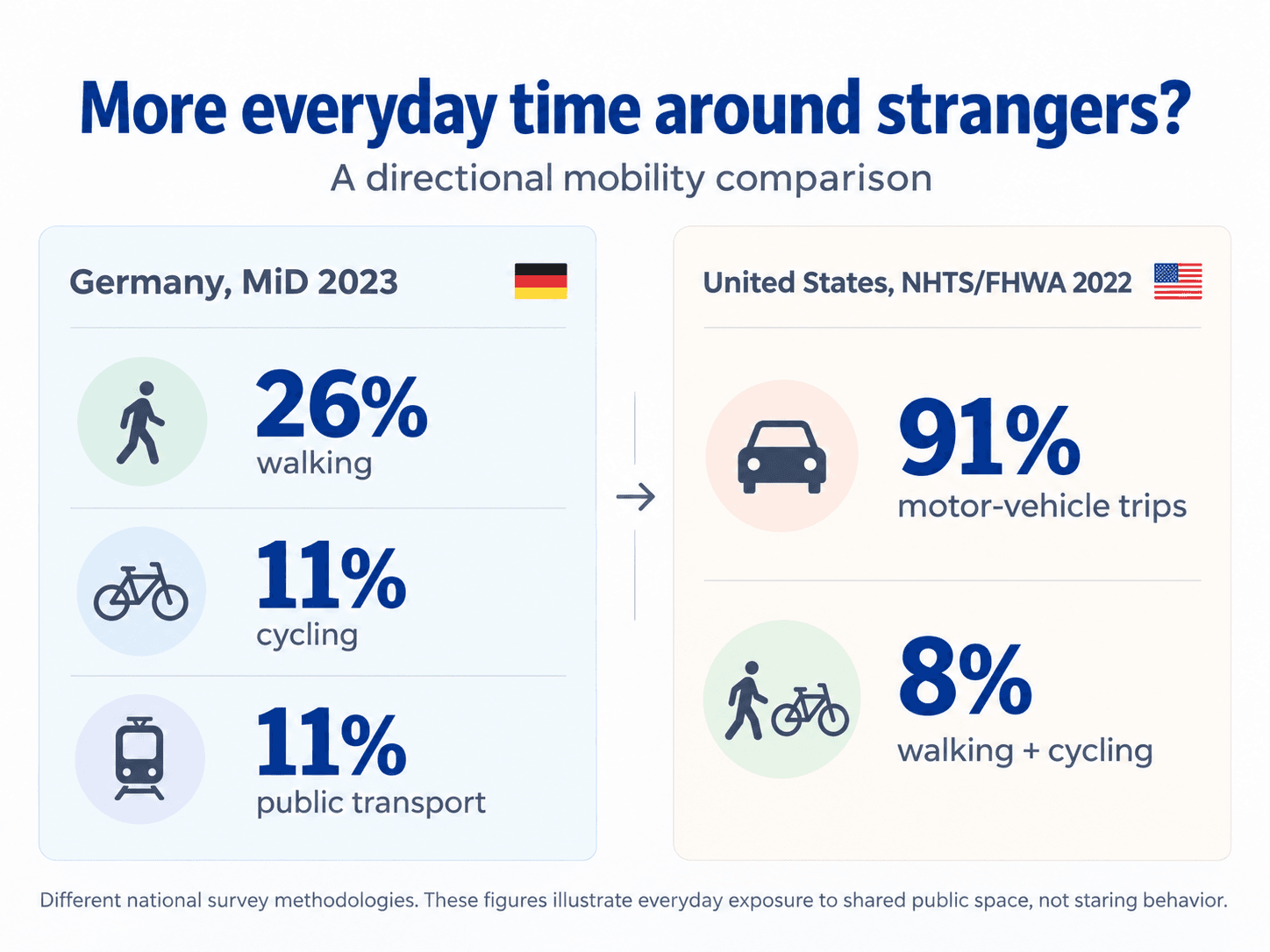
Germany’s Mobility in Germany 2023 survey found that 26% of trips were made on foot, 11% by bicycle, and 11% by public transport.
US federal travel data paint a very different directional picture. According to the Federal Highway Administration’s 2022 travel data, motor vehicles accounted for 91% of US trips, while walking and cycling together accounted for 8%.
These are different national surveys with different methodologies, so this is not a perfectly harmonized international mobility comparison. And it certainly is not a staring statistic. But consider the everyday implication.
If moving to Germany means you now spend much more time, you simply have more opportunities to look at strangers and to notice strangers looking at you:
- walking through shared streets,
- waiting on platforms,
- sitting opposite strangers on trains,
- using trams,
- standing in queues,
- or sharing dense public spaces.
For an American newcomer in particular, part of the perceived cultural difference may therefore be a difference in exposure. More strangers around you means more interactions with strangers to interpret.
Then look at your own reference point
Looking outward is only half the picture. The other half is what you bring into the interaction. This does not mean you imagined it.
It means no social signal reaches our brain without an existing reference point.
What feels like “normal looking” to you?
Imagine two people receive exactly the same look. One grew up somewhere where strangers often look each other directly in the eye. The other grew up somewhere where sustained eye contact with a stranger can mean: What are you looking at?
The observable behavior can be identical. The experience is not.
This is why we should be cautious when someone tells you there is one precise number of seconds after which a German look becomes a German stare. The research does not give us that number.
When you are new, you are watching too
Moving abroad turns you into an observer. You want to fit in and actively notice:
- how people board a train,
- how loudly they speak,
- whether they smile,
- where they stand,
- what they wear,
- how they queue,
- and how strangers react to one another.
You are trying to understand the unwritten rules. That makes unfamiliar things easier to notice.
This is consistent with general ideas about novelty and habituation, but we do not have a German longitudinal study showing that newcomers reliably stop noticing the German stare after a certain number of months or years.
Community reports also contradict one another: Some long-term residents say they barely notice it anymore. Others say they still find it uncomfortable after many years. So, some people may become accustomed to the experience. Others do not.
I experience this myself whenever friends visit me somewhere I already know well. They say: That’s strange. Sometimes I suddenly remember thinking the exact same thing when I first arrived. Then it became normal.
And becoming accustomed to something does not prove the external behavior changed. Sometimes your attention changes.
Do you feel like you stand out?
There is an important distinction between: Do I stand out in this environment? vs. Do I feel like I stand out?
When you are new to a country, unfamiliar with the language or visibly different from many people around you, social attention can feel more personally relevant. You may monitor people’s reactions because you are still trying to answer:
- Am I doing this right?
- Do I fit in here?
- Was that about me?
That does not make the gaze imaginary. It means your own sense of being conspicuous can change how important the gaze feels.
Expectations can shape the story we tell about a look
Germany also arrives with baggage:
- Strict.
- Serious.
- Efficient.
- Organized.
- Rule-following.
These are stereotypes — not measurements of what German individuals are actually like. But stereotypes can shape how people interpret ambiguous behavior.
One cross-European study of national stereotypes found that Germany rated higher on competence than warmth, while Spain and Italy fell on the relatively warmer-than-competent side of the stereotype map.
Again: this describes stereotypes. It does not tell us the actual personalities of Germans, Spaniards or Italians. But imagine the same silent look under two different expectations.
If you already expect the German person to be strict, serious, or rule-focused, the look may fit naturally into a story of: They are judging me. If your stereotype of another culture emphasizes warmth or sociability, you might build a different story around the same ambiguous behavior.
We do not have an experiment showing that this specifically causes the German-stare effect. But it is a plausible narrative amplifier. And social media adds another layer: once someone tells you about the German stare, you know to look for it.
How German is the German stare, really?
The idea of assigning a national label to staring isn’t unique to Germany.
We compared English-language search demand and public discussions for several European nationality + stare combinations in October 2026. “Swiss stare” had measurable demand in Switzerland, and we found smaller search or discussion signals for Poland, France, Spain, Austria, Italy, and the Netherlands.
We treat search demand as evidence of discourse, not evidence of how often people actually stare, either. But it suggests something useful: Turning an unfamiliar style of looking into a nationality-specific story is itself not uniquely German.
The German version is simply unusually successful as an English-language meme and search concept. Hence, the German stare is not the only national “stare” narrative — but it is unusually visible.
So what does a German stare actually mean?
Usually, a look by itself gives you surprisingly little information.
That can be unsatisfying. But it is more accurate than pretending every stare has a cultural translation. What matters is what else is happening. Someone looking at you on a train with a neutral face could be:
- observing,
- bored,
- thinking,
- curious,
- attracted,
- distracted,
- looking at something near you,
- or simply somebody who looks at people more than you do.
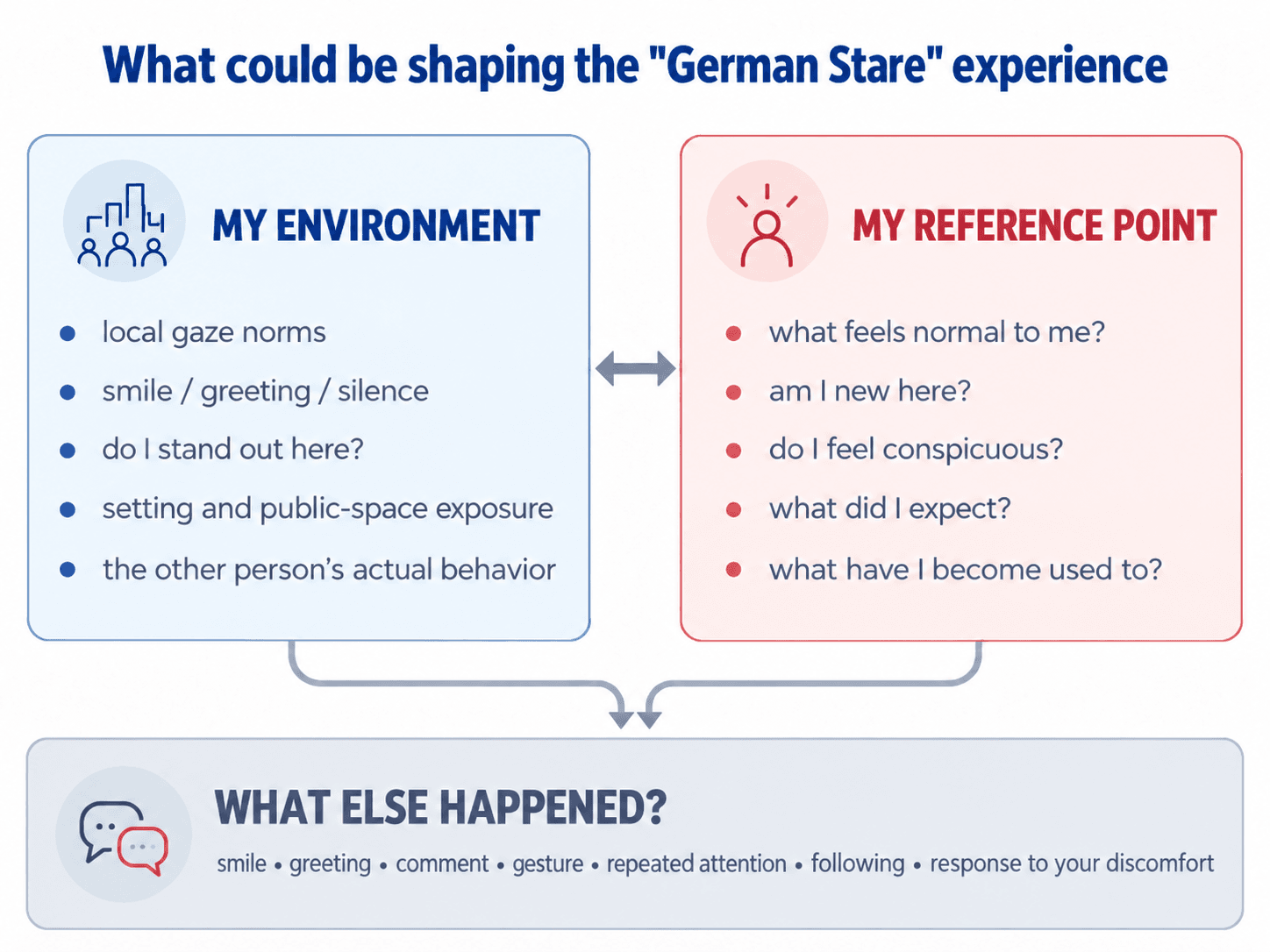
A look accompanied by a smile is different. A look accompanied by an insulting comment is different. Repeatedly focusing on one specific person is different from glancing at everyone around you. And continuing after somebody has clearly signaled discomfort tells you more than nationality ever will.
| What happened? | What can you reasonably conclude? | What you might do? |
|---|---|---|
| Quick, curious or slightly awkward look | Probably very little. It may be ordinary looking, curiosity or mindless observation. | Ignore it, briefly look back, smile/nod if you want — or just enjoy the awkwardness. |
| Repeated but non-hostile staring | More noticeable, maybe annoying or funny, but the motive is still unclear. | Ignore it, move your attention elsewhere, change position if you want, or respond lightly if the situation feels playful. |
| Looking + smile / greeting / obvious social interest | Additional signals give you more information than gaze alone. It may be friendly attention or flirting, but context still matters. | Smile back, engage if you want, or simply continue what you were doing. |
| Persistent staring after you clearly show discomfort | This is becoming less about cultural ambiguity and more about a personal boundary. | Create distance, change seats or communicate your boundary if you feel comfortable doing so. |
| Staring + insults, threats, following or discriminatory gestures | This is no longer usefully explained as a “German stare.” | Prioritize safety, leave the situation, seek support and document/report serious behavior where appropriate. |
Most German-stare situations are probably much closer to the top of that table than the bottom. There is a reason the phenomenon works so well as a meme. Sometimes it is simply weird and funny:
- You look at someone.
- They look at you.
- Nobody knows what is happening.
- And somehow nobody looks away.
Does the German stare mean flirting?
It can:
- So can smiling at you.
- Or sitting next to you.
- Or asking what you are doing later.
But gaze alone is weak evidence. If someone is genuinely trying to connect with you, they will usually send other social signals worth paying attention to.
Do not try to translate the duration of eye contact into a secret German romantic code.
Do you get used to the German stare?
Some people say they notice it less when feeling at home in Germany. Others continue to find it noticeable or uncomfortable after many years. Habituation is plausible, but there is no Germany-specific longitudinal study showing that everybody eventually stops noticing it.
Do Germans stare at foreigners?
This is where overly simple explanations become particularly unhelpful.
In our review of community discussions, visibly foreign and POC users sometimes asked whether what they were experiencing was “the German stare” or targeted attention related to their appearance or race.
A look by itself usually cannot answer that question. It would be just as irresponsible to say: Yes, that’s definitely racism as Don’t worry, Germans just stare.
Instead, look for additional information:
- Is one person repeatedly targeting you?
- Are there comments?
- Gestures?
- Mocking?
- Slurs?
- Following?
- Photographing?
- Threats?
- Does the person continue after you clearly show that the attention is unwanted?
Culture can help explain an ambiguous interaction. It shouldn’t be used to excuse clearly hostile behavior.
When does looking become rude?
No one has a scientifically established stopwatch for when a German is considered rude for staring.
Personally, my boundary is fairly simple: If somebody makes it clear they are uncomfortable, and you deliberately keep staring anyway, it has stopped being innocent looking.
That is my judgment, not a national rule. And individual Germans vary enormously here. I have German friends who seem barely interested in what anybody around them is doing. Others will openly watch something for much longer. Attaching the word “German” to the behavior can make us forget that basic individual variation.
Cultural counterexamples also make the stereotype interesting. Think about a German sauna or an FKK beach.
There can be plenty of naked bodies around, yet in my experience, obviously staring at somebody would be particularly intrusive.
The most visually revealing thing isn’t automatically what people consider socially appropriate to inspect. Context matters.
What should you do when somebody stares at you?
Most of the time? You do not need to solve the mystery.
- You can ignore it.
- You can look back briefly.
- You can smile.
- You can nod.
- You can laugh internally at finally experiencing the famous German stare.
If somebody continues looking and you find it annoying, you can move or disengage.
If there are clear additional signs of hostility, discrimination, or threatening behavior, stop worrying about whether the interaction is “German” and respond to the behavior itself.
And although Reddit loves this solution, you don’t have to win the staring contest.
Sometimes staring back is funny. Sometimes a smile breaks the awkwardness. Sometimes doing absolutely nothing is the most German response available.
Still wondering what that look meant?
Tell the Culture Decoder what happened. We’ll help you work out how much German culture actually explains it — and whether it was more personal or just rude.
The bottom line
So, is the German stare real?
As a cultural story and internet phenomenon: absolutely.
As a scientifically demonstrated fact that Germans objectively stare longer or more often than everyone else? We don’t have good evidence for that.
The more interesting explanation may be that several things come together:
- different expectations around gaze,
- different social signals surrounding a look,
- spending more time around strangers in public,
- standing out in a particular environment,
- being new and paying closer attention yourself,
- feeling conspicuous or foreign,
- stereotypes and expectations,
- and simple individual variation.
That is why two internationals can spend years in Germany and come away with completely different opinions about whether the German stare even exists.
And it is why the best question is usually not Why are Germans staring at me? but
What is happening in this particular situation — around me and for me?
How we researched this article
We reviewed peer-reviewed research on cross-cultural eye contact, emotional display rules and social signaling, alongside official mobility data from Germany and the US.
We also analyzed English-language search demand and reviewed public community discussions to identify common situations and conflicting experiences. Community posts were used for qualitative context, not prevalence estimates.
First-hand observations from our German editor are clearly presented as personal experience rather than evidence about Germans generally.
What we did not find: a good comparative study showing that Germans objectively stare more often or longer than people elsewhere.
See all sources
- Sorokowska et al. (2026): Cross-cultural variation in eye contact comfort
- Boer et al. (2024): Variations in the Appearance and Interpretation of Interpersonal Eye Contact in Social Categorizations and Psychiatric Populations Worldwide
- Matsumoto et al. (2008): Mapping Expressive Differences Around the World
- Rychlowska et al. (2015): Heterogeneity of long-history migration explains cultural differences in reports of emotional expressivity and the functions of smiles
- Duden et al. (2026): Inside-Out
- Bundesministerium für Verkehr (2026): Mobility in Germany 2023
- Federal Highway Administration (2026): National Household Travel Survey using 2022 data
- Settle in Germany (October 21, 2026): Ubersuggest analysis
- Schmid et al. (2025): Stereotypes as Strategic Assets
- Know Your Meme (October 21, 2026): German Stare
- Settle in Germany (October 21, 2026): Analysis of public community discussions (e.g. Reddit, public forums)
