
How to Make Friends
in Germany
Meeting people is usually not the hardest part. The real challenge is finding people who have room for a new friendship — and recognizing which acquaintances are becoming mutual, chosen relationships.
How making friends in Germany actually works
There is no single German app, club or trick that creates friendship. A more useful strategy is:
- Find people who are open to new connections
- Meet them in a setting that makes interaction easy
- Move promising contacts beyond that original setting
- Invest where the relationship becomes mutual.
A newcomer event can introduce you to someone. A Verein can put you next to the same person every Tuesday. A mobile app can match you. A Welcome Week can fill your phone with new contacts. But none of those things is the friendship itself.
The important transition is often this: You stop meeting only because the setting puts you together — and start choosing to spend time together.
Research on friendship formation supports that distinction. Time together is associated with greater closeness, but how people spend that time matters too: leisure and everyday conversation were more informative for closeness than simply sharing a workplace or classroom.
That does not mean there is a universal “X hours = friendship” formula. And the goal does not need to be a circle of German friends. A good social life in Germany might include Germans, other internationals, people from your own country, or a mixture of all three.
The more useful question is: Do I have a few people here who are genuinely becoming part of my normal life?
A large 2025 meta-analysis covering 1,114 studies and 571,260 migrants, international students, expatriates and refugees found that social resources — especially feeling connected and not feeling lonely — were among the strongest positive correlates of adaptation to life in a receiving society. It does not tell us what nationality your friends need to have.
Quick reality check
- How many genuinely new close friends did you make in your home country in the last five years?
- How many of your closest friendships started at school, university, a long-term workplace or another setting where you saw the same people repeatedly?
- Are you comparing a few months in Germany with a social network that took years or decades to build somewhere else?
This does not mean Germany-specific friction is imaginary. Expats do report Germany as socially difficult. But rebuilding a network as an adult is difficult in ways that are not uniquely German.
Start with friendship capacity, not nationality
A common question is: Are Germans open to friendship?
That is too broad to be very useful. A better question is: Does this particular person, in their current life, actually have room for another friendship?
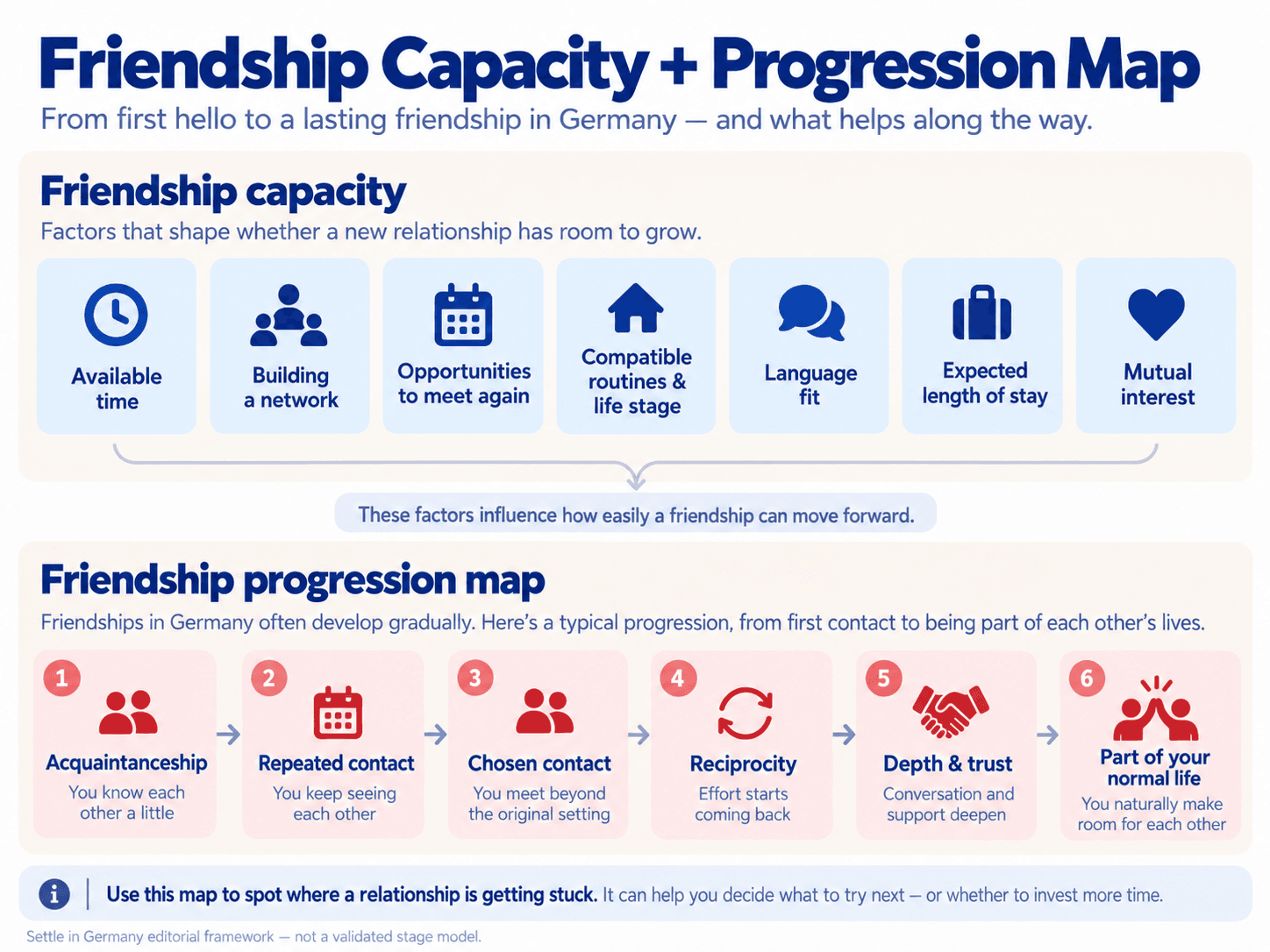
We use friendship capacity as a Settle in Germany editorial framework. It is not a validated psychological score. It simply brings together factors that can affect whether a new relationship has room to grow:
- available time
- whether someone is currently building a network
- opportunities to meet again
- compatible routines and life stage
- language fit
- expected length of stay
- mutual interest
Time can be a bigger constraint than interest
Someone can genuinely like you and still have almost no free time.
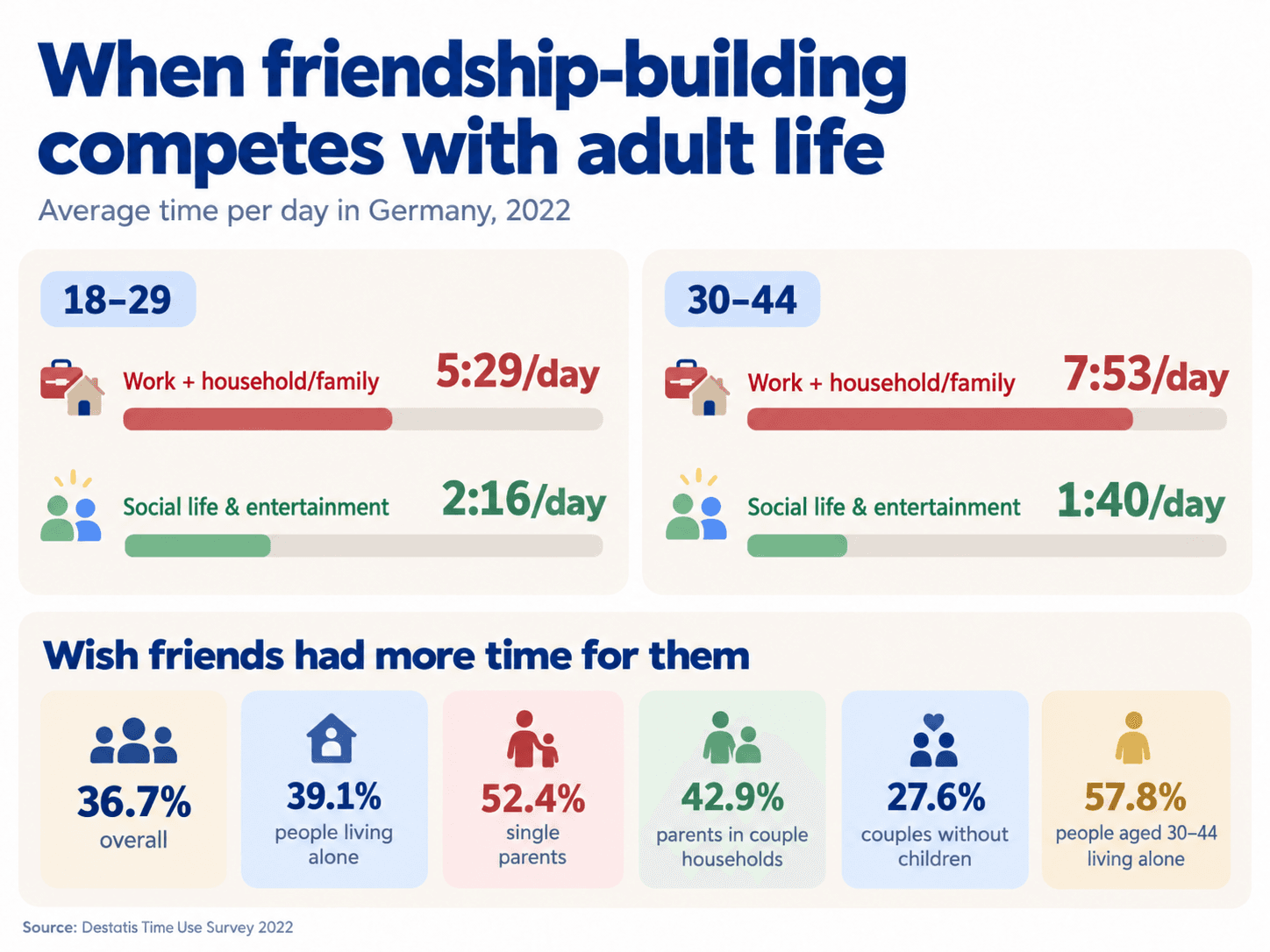
Germany’s 2022 Time Use Survey involved around 20,000 people and gives a useful picture of how much life stage changes the available time budget.
On an average day, people aged 18–29 spent about 3:34 hours on employment/job search and 1:55 hours on household and family responsibilities — a combined 5:29 hours. Among 30–44-year-olds, those figures were 4:05 hours and 3:48 hours, or 7:53 hours combined.
At the same time, the published age-group data show the average time for social life and entertainment of:
- 2 hours 16 minutes among 18–29-year-olds
1 hour 40 minutes among 30–44-year-olds
That does not mean people in their 30s and early 40s want fewer social relationships. When people were asked whether they wished their friends and acquaintances had more time for them, 36.7% overall agreed or rather agreed. The share was:
- 39.1% among people living alone
- 52.4% among single parents
- 42.9% among parents in couple households
- 27.6% among couples without children
Among people aged 30–44 who lived alone, the figure reached 57.8%.
These figures concern time with existing friends and acquaintances. They do not tell us who is actively looking for new friends. But they make one distinction useful: Wanting more social contact and having room to create it are not the same thing.
People rebuilding a network may be easier to connect with
A recurring theme in the public discussions we reviewed was that people who had recently moved — German or international — sometimes felt easier to connect with than people whose lives in a place were already well established.
That shouldn’t become a rule. Some newcomers have no interest in new friendships. Some lifelong locals are extremely open. But there is a plausible mechanism: Two people who both need new connections have a reason to invest.
Research on migration and social networks supports the broader idea that moving requires rebuilding friendship networks. One study following Germans who moved abroad found that friendship-network size after migration was associated with factors including identification with the destination and the intention to stay.
So instead of filtering by nationality, it can be useful to notice whether someone is:
- new in town
- studying away from home
- relocating for work
- looking for a regular activity partner
- otherwise going through a social transition
In my experience, people who have rebuilt a social life before can sometimes seem more understanding of what it feels like to be new. That is a personal observation, not an established population-level effect.
Your routines also need to fit
Compatibility is not only about personality. Sometimes it is logistics:
- Can you both meet on weekday evenings?
- Do you both have flexible weekends?
- Does one person have young children while the other mainly wants spontaneous late-night plans?
Longitudinal German research on social networks and parental status found strong evidence that having young children reduces the likelihood of initiating new network ties. It also found evidence of greater tie persistence — and among women, some new tie formation — between people with the same parental status.
That does not make parents poor prospects for friendship. It means that friendships are easier to maintain when the relationship fits into both lives.
Expected permanence may influence investment
Some residents in public discussions explicitly say they are less motivated to invest heavily in someone they know will leave again after a short stay.
We do not have representative evidence showing how common that attitude is among established Germans. What we do have is migration research linking intended length of stay with friendship-network size after moving abroad. So the useful takeaway is modest: matching expectations about how long you will be around may help.
If you are staying long-term, mentioning that naturally can remove uncertainty. If you are only in Germany temporarily, that does not make meaningful friendship impossible — but people whose time horizons resemble yours may be particularly realistic contacts.
Language fit matters more than “Do you speak German?”
German usually expands your social options. A longitudinal German study of interethnic friendships found that German-language skills were particularly important in explaining differences in friendship patterns between migrant groups, alongside opportunity structures, preferences, and social context.
A 2026 review of international students likewise identifies proficiency in the host country’s language as an important factor in local participation.
But the deeper mechanism is not German = friendship; it is closer to: Friendship is easier when both people can interact naturally in the same language.
English can be sufficient when it genuinely functions as the shared social language — for example, in an international workplace, an English-speaking study program, or a mixed friendship group. German becomes more important as the surrounding network becomes more German-dominant.
This is particularly noticeable in groups. One German person may happily speak English with you all evening. A German-speaking group may naturally return to German once conversation becomes fast, humorous, or emotionally detailed.
Language fit
- What language does this person or group naturally socialize in?
- Can both of us joke, tell stories and talk about personal things comfortably?
- Is one person constantly doing extra linguistic work?
- Is this one-to-one or a German-dominant group?
There is no evidence for a friendship threshold such as B2 or C1. The useful goal is social ease, not perfect grammar.
Where to actually meet people in Germany
There are three useful ways to create friendship opportunities:
- High-intent settings are places where people are explicitly open to meeting others.
- Recurring settings repeatedly put you around the same people.
- Sometimes the best option is to create a small opportunity yourself, especially where dedicated newcomer infrastructure is limited.
A setting does not have to be recurring to be useful. A Welcome Day can be strong because many participants are socially new. A weekly Verein offers a different advantage: continuity. Buddy programs and recurring newcomer groups can combine both.
The more important question is not which activity automatically creates friends, but whether this setting makes it easier to meet compatible people — and whether I can create a next interaction from it.
Apps and online platforms
Newcomer and welcome formats
Recurring activities
If you live in a smaller town or village
Do not assume the Berlin strategy works everywhere. Large cities tend to have more dedicated international groups, newcomer formats, and specialist social events. In a smaller town, the relevant infrastructure may be more local:
- Sportvereine
- Musik- or Kulturvereine
- voluntary organisations
- Freiwillige Feuerwehr
- municipal events
- Dorffeste or Stadtfeste
- local VHS courses
- parents’ groups
- neighborhood networks
Germany’s latest nationwide volunteering survey again shows how important voluntary engagement remains as organized community participation.
The practical point is not that rural people are automatically friendlier. The infrastructure through which you encounter people may be different. Useful searches include:
[town] Veranstaltungen[town] Vereinsverzeichnis[town] Ehrenamt[town] Sportverein[town] Stadtfest
Your neighborhood is also an opportunity
You already have one useful ingredient: proximity. Platforms such as nebenan.de support local groups, events, and recurring neighborhood formats such as Stammtische. But you do not need an app to introduce yourself.
In a small apartment building or socially active neighborhood, introducing yourself can be enough: Hi, I just moved into number 12. I’m Alex — nice to meet you. Want to grab a coffee sometime?
What about bringing muffins or cake?
You can, if it feels natural. But do not treat it as a German custom or expectation.
Community reactions to introducing yourself to neighbors are mixed. In a small house or close neighborhood, a homemade gesture may feel warm. In a large anonymous building, some people may find it unnecessary. Read the setting.
Local festivals can be good discovery settings
Unlike a weekly club, a Dorffest or Stadtfest offers social permission to talk. People are already outside and participating in something local.
But the event itself is still only discovery. Move from German small talk to exchanging contact details and organizing a coffee, walk, or any other activity.
The crucial step: change the context
This is one of the most useful principles in the whole process.
You can meet someone at Welcome Week, a Newcomer Stammtisch, Meetup, tennis, VHS, work, volunteering, Timeleft, a Dorffest, or your apartment building. But if every interaction depends on the original setting, the relationship can remain context-bound.
Ask yourself whether you would still see each other if this setting disappeared tomorrow. When you repeatedly enjoy someone’s company, create a small opportunity to find out. The aim isn’t to force intimacy, but to give the relationship a chance to become chosen.
From social setting to chosen contract
| Starting point | Possible next step |
|---|---|
| Welcome Week | Invite 1–3 people for lunch or city exploration |
| Newcomer Stammtisch | Message one person before the next Stammtisch |
| Meetup | Create a smaller follow-up around the shared interest |
| Verein | Stay after training, then suggest something unrelated |
| Tennis partner | Coffee after playing, then meet without tennis |
| Language tandem | Meet without language practice as the main purpose |
| Work | Start with after-work drinks and then suggest something clearly outside work |
| Volunteer group | Coffee or food after the activity |
| Dorffest | Exchange details and then suggest a small follow-up |
| Neighbor | Have a small chat, invite for coffee at your place or a walk |
How acquaintances become friends
We use this practical map with the following stages:
- Acquaintanceship
- repeated contact
- chosen contact
- reciprocity
- depth/trust
- part of your normal life
This is a Settle in Germany editorial framework, not a validated stage theory. Friendships can skip steps, happen in another order, or develop unevenly. Its value is diagnostic: it helps you notice where a relationship is stuck.
Repeated contact creates opportunity
Friendship research suggests that time together matters, but proximity alone is insufficient.
Time was more predictive of closeness in relationships of choice than in closed systems such as work or school, and leisure activities and certain forms of everyday conversation were associated with greater closeness. That is why you can work beside someone for years without becoming private friends — while another relationship can develop much faster.
Repeated contact mainly gives a relationship more chances to develop.
Chosen contact is an important signal
You are no longer together only because work requires it, tennis happens every Thursday, or class starts at 6 pm. You start choosing the interaction.
In my own life, some colleagues only became close friends after we left the job.
While we worked together, I kept professional boundaries. In private, I want to complain about work or say something unpolished without worrying it could affect my job. Other colleagues became close friends while we still worked together because shared experiences—business trips, team events, or difficult periods—built much more personal trust.
That is one person’s experience, not a German rule. But it shows why daily contact isn’t the same as chosen contact.
Look for reciprocity
At some point, friendship-building should stop feeling like a solo project. You do not need perfect 50/50 initiative. But something should come back.
They may initiate sometimes, suggest another date when they cannot come, remember what you told them, make room for you, offer help, accept help, or want to meet when the original activity is not happening.
A representative 2022 survey of friendship values in Germany found that:
- 64% associated friendship with being there when the other person needs them
- 63% valued the reverse
- 63% valued being able to talk about everything
- 62% valued honesty
That tells us more than clichés like German friends are loyal for life.
The table below gives an overview of friendship signals. These are heuristics, not a friendship score.
Stronger vs. weaker friendship signals
| Stronger signals | Weaker or ambiguous signals |
|---|---|
| They follow through | They text fast |
| They counter-propose | They say “we should do that sometime” |
| They initiate sometimes | They call you Freund/Bekannter/Kollege |
| They spend voluntary time with you | They are friendly at work/class |
| They repeatedly make room | They like your social posts |
| They help or accept help | They are enthusiastic one evening |
| Conversation deepens | They are initially reserved |
Do not use texting as your friendship thermometer
A representative 2026 survey of messaging habits in Germany found that 69% of messenger users at least occasionally leave messages unanswered for longer because the volume feels like too much.
At the same time, very long response delays can matter: 69% said long delays can at least occasionally contribute to a contact fading or ending. But slow replies alone are weak evidence.
Slow replies combined with no meetings, no initiative, and no follow-through tell you much more. That fits my own habits.
I can go weeks without messaging some of my best friends. Personal contact matters much more to me.
Do not over-read “Bekannter”
Some internationals find the German distinction between Freund, Bekannter and Kollege surprisingly sharp.
A nine-country friendship survey from 2019 found an average of 3.2 “best friends” in Germany and 3.1 in the US. The exact wording and methodology mean this should not be treated as a perfect Germany-vs.-US comparison, but it is a useful counterweight to the idea that Germans necessarily have dramatically smaller intimate friendship cores.
Some of the perceived difference may therefore be about labels and thresholds rather than fundamentally different capacities for close relationships.
Even Germans don’t use these labels consistently: If you asked me carefully who my real friends are, I would reserve that category for people I trust almost like family. In everyday conversation, I may use friend more loosely. Behavior is often more informative than the label.
Verbal enthusiasm is not follow-through
Common advice says Germans require extremely concrete invitations. Our research does not support treating that as a universal German rule:
- Personally, I might say We should do that sometime and genuinely mean it.
- If somebody said the same thing to me and I was interested, I might simply answer: Sure — when?
So do not spend too much energy decoding the exact wording. Watch what happens next and whether the positive intent becomes an actual plan.
Is Germany actually harder?
Many internationals report that it is harder to build a social network that makes you feel at home in Germany.
In a 2026 survey of expats living around the world, Germany ranked 28th out of 31 destinations on the Ease of Settling In Index. 57% of expats in Germany said making local friends was difficult, compared with 40% globally.
But that does not directly measure how willing established Germans are to add newcomers to their friendship circles.
The survey measures expat experiences, and respondent populations differ between countries in migration motive, life stage, and other ways. Its methodology also means country rankings should be interpreted as experience surveys, not direct measurements of national personality.
There is also some Germany-specific qualitative evidence.
A 2026 study based on interviews with 36 migrants in Berlin, Bremen, Leipzig and Stuttgart identified a theme the researchers called social minimalism — participants described relatively limited social signaling in some everyday German interactions.
The study explicitly does not claim to represent all migrants or all Germans. That may help explain why first contact can feel less warm for some newcomers. But it does not justify claims such as Germans are inherently closed or German friendships always take years. Some of the difficulty may instead reflect a mixture of:
- moving as an adult
- established social circles
- language friction
- limited time
- professional boundaries
- mismatched expectations
- low friendship capacity
Still wondering how German friends behave?
Tell the Culture Decoder what happened. We’ll help you work out how much German culture actually explains it — and whether it was more personal or just rude.
A practical friendship strategy
If you want the whole article reduced to a process:
1. Put yourself where new connections are likely
That might be a newcomer event, a recurring activity, an app or platform used by people actively looking for company, a neighborhood context or an opportunity you create yourself.
Do not assume repetition is the only route. A one-off Welcome Day can work well for matching because the social intention is unusually clear.
2. Notice friendship capacity
Do not use nationality as a shortcut. Ask yourself whether the person:
- has time
- is building a network too
- has routines that fit yours
- can communicate comfortably with you
- has a compatible expected time horizon
- shows actual mutual interest
3. Let acquaintanceship happen first
You do not need to decide after one coffee whether someone will become a close friend. Some people will remain acquaintances. That is normal.
4. Change the context
If you consider someone being friendly, arrange a meeting outside the current setting (e.g., a recurring or newcomer event). You can meet them for private coffee, lunch, or just a walk. The goal is to move from we happen to be here together to we are choosing to meet.
5. Be reliable
German friendship surveys suggest people value mutual care, openness, and honesty. In practice, reliability can also help build trust early on. That does not mean rescheduling is forbidden. If something changes, communicate. When appropriate, suggest another option.
- I can’t do Thursday. Are you free Sunday?
- I hurt my foot, so I can’t play tennis. Want to get coffee instead?
In my own experience, an early cancellation can feel more significant in a one-to-one meeting than in a large group because the other person may have planned around it. That’s personal experience, not a general German rule.
6. Watch whether initiative comes back
Eventually ask yourself: Is this becoming mutual? Don’t carry the whole relationship indefinitely.
7. Invest selectively
If someone is friendly but consistently unavailable, the relationship may stay light. If someone responds, initiates, and makes room for you, invest more.
You do not need 50 new friends in Germany. You need a few people here who become part of your normal life.
8. Build a circle, not one perfect friend
Your circle might eventually include:
- a sport friend
- a former coworker
- another international
- someone from university
- a neighbor
- a German friend
- someone from your home country
They do not all have to provide the same kind of relationship. And they do not all need to be German.
If you are trying but nothing is changing
Sometimes the answer is not to try harder. It is identifying where the process is stuck.
How we researched this article
This article combines several types of evidence rather than treating any single source as a complete explanation of friendship in Germany.
We reviewed peer-reviewed research on friendship formation, social networks, migration, language, life stage, and belonging; official German data, representative German friendship and communication surveys; and current official sources for activities, newcomer programs, and social platforms. We also reviewed current search results and public discussions by internationals and Germans. Community discussions were used to identify recurring situations, language, and counterexamples — not to estimate how common a behavior is.
The Friendship Capacity + Progression model in this article is a Settle in Germany editorial framework. It combines established findings and practical observations to help readers decide where to invest their social effort. It is not a scientifically validated friendship scale or stage model.
The German editor includes first-hand observations where they help illustrate how a situation can look in real life. They present these as personal experience, not as evidence of how all Germans behave.
What we did not find: We found no strong representative cross-country evidence directly measuring how willing established Germans are to add newcomers to their close friendship circles. We also found no scientifically validated “friendship capacity” score, no universal timetable for becoming friends, and no evidence-based German-language level such as B2 or C1 at which friendship suddenly becomes possible.
See all sources
- Hall, J. A. (2019): How many hours does it take to make a friend?
- Lois et al. (2023): Parental status homogeneity in social networks
- Schacht et al. (2014): Interethnische Freundschaften in Deutschland
- Décieux et al. (2021): Emigration, Friends, and Social Integration
- Duden et al. (2026): Inside-Out
- Bierwiaczonek et al. (2025): A meta-analysis of social and contextual correlates of migrant adaptation to living in receiving societies
- Statistisches Bundesamt (2025): Zeitverwendungserhebung
- SINUS-Institut & YouGov (2022): International Day of Friendship 2022 survey
- Bitkom Research (2026): Nachrichtenflut
- OECD (2026): International Students in Higher Education
- InterNations (2026): Expat Insider 2026
- Snap Inc. (2019): The Friendship Report
- Federal Government of Germany (2025): Freiwilliges Engagement in Deutschland
