

Compare Fixed Deposits in Germany
Enter your savings amount and preferred term to compare current fixed-deposit offers. Our calculator shows the available interest rates and estimated returns for the period you select.


What Is a Fixed Deposit (Festgeld)?
A fixed deposit, known in Germany as Festgeld or a Festgeldkonto, is a savings account in which you deposit money for a predetermined period at a fixed interest rate.
Unlike a Tagesgeld account, your money is usually locked in for the agreed term. Common terms range from a few months to several years. During this period, you generally cannot withdraw the money early without restrictions or, depending on the provider, at all.
The main advantage is that the interest rate is fixed for the entire term. This gives you a predictable return even if market interest rates fall after you open the account.
At the end of the term, your original deposit and the interest earned are paid out or made available in accordance with the provider’s maturity conditions.
When Is a Fixed Deposit a Good Choice?
A fixed deposit can be a good option when you know that you will not need part of your savings for a defined period and want a predictable return.
Typical use cases include:
- Saving for a known future expense: for example, money you expect to need in one, two, or three years.
- Locking in an interest rate: useful if you prefer certainty and do not want your return to change when variable savings rates fall.
- Separating long-term cash from your emergency fund: money that you do not need for day-to-day liquidity can be placed in a fixed deposit while more accessible savings remain in a Tagesgeld account.
- Reducing the temptation to spend: because the money is locked away for a fixed term, it can be easier to leave it untouched.
The main trade-off is reduced flexibility. Early withdrawals are often not possible or are allowed only under limited conditions. If you may need the money at short notice, a Tagesgeld account is usually more suitable.
How to Compare Fixed Deposits
The highest advertised interest rate is not always the best fixed-deposit offer for your savings plan. A longer term may pay a higher annual rate, but it also means giving up access to your money for longer.
When comparing fixed deposits, check:
- Annualized return: compare the yearly return rather than looking only at the total interest earned over different terms.
- Term: choose a maturity date that matches when you expect to need the money.
- Minimum and maximum deposit: some offers only accept deposits within a defined range.
- Interest payment: interest may be paid annually, at maturity, or according to another schedule.
- Early withdrawal rules: many fixed deposits cannot be terminated early except in limited circumstances.
- Maturity conditions: check whether your money is paid out automatically or whether the deposit renews unless you cancel it.
- Deposit protection: verify which bank holds your deposit and which guarantee scheme applies.
- Eligibility and opening route: some offers may have residency requirements or be available through a savings platform rather than directly from the bank.
A higher rate can be attractive, but the best term is the one that fits your liquidity needs. Locking money away for several years just to earn a slightly higher annual return may not be worthwhile if there is a realistic chance you will need the funds earlier.
Which Fixed Deposit Term Should You Choose?
The right fixed-deposit term depends mainly on when you expect to need the money and how long you are comfortable locking it away.
A shorter term offers more flexibility, while a longer term can sometimes provide a higher annual return. However, choosing the longest available term is not always the best option.
As a general rule:
- 3–12 months: useful if you want to lock in a rate without tying up your money for too long.
- 1–2 years: can suit medium-term savings goals where you are reasonably confident you will not need the money earlier.
- 3–5 years: may be appropriate for savings you can comfortably leave untouched for several years.
- Longer than 5 years: offers the least flexibility and should only be considered if the maturity date clearly matches your financial plans.
Before choosing a term, ask yourself:
“What is the earliest point at which I might realistically need this money?”
It is usually better to choose a slightly shorter term than to lock away too much of your savings for longer than you are comfortable with.
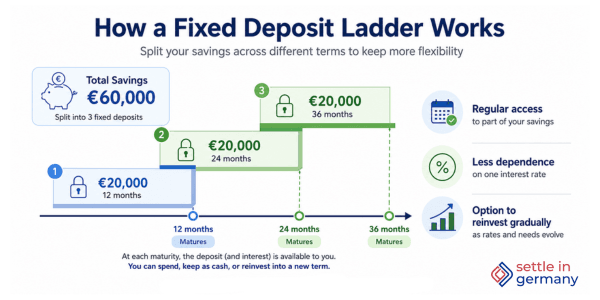
If you want to benefit from fixed rates without committing all of your money to one maturity date, you can also split your savings across several fixed deposits with different terms. This is known as a fixed-deposit ladder.
Fixed Deposit Ladder: How to Keep More Flexibility
A fixed-deposit ladder means splitting your savings across several fixed deposits with different maturity dates, rather than locking the full amount away for a long term.
For example, instead of placing €60,000 into a single three-year fixed deposit, you could divide it into:
- €20,000 for 12 months
- €20,000 for 24 months
- €20,000 for 36 months
This way, part of your savings becomes available each year. When a deposit matures, you can decide whether to use the money, move it to a Tagesgeld account, or reinvest it into a new fixed deposit.
The main advantages are:
- More regular access to your money
- Less dependence on one interest rate
- Greater flexibility if market rates change
- The option to reinvest gradually instead of all at once
The trade-off is that managing several deposits requires a little more administration, and shorter-term deposits may offer lower rates than longer maturities.
A fixed-deposit ladder can therefore be useful if you want the predictability of Festgeld but do not want all of your savings locked away until the same date.
What Happens When a Fixed Deposit Matures?
When a fixed deposit reaches the end of its agreed term, it matures. What happens next depends on the provider’s conditions.
Typically, you should check whether:
- your deposit and interest are paid out automatically;
- the money is transferred to your reference or settlement account;
- you need to give instructions before maturity; or
- the fixed deposit automatically renews for another term.
The last point is particularly important. Some fixed deposits may be extended automatically if you do not cancel or provide instructions before the relevant deadline. The Verbraucherzentrale therefore recommends checking the maturity and cancellation conditions in advance and noting any applicable deadline.
If your deposit is paid out at maturity, you can then decide whether to:
- use the money;
- move it to a flexible Tagesgeld account;
- open a new fixed deposit at the rates available at that time; or
- reinvest only part of it into a fixed-deposit ladder.
Do not assume that every Festgeld account ends automatically without action. Check the provider’s maturity and renewal rules when you open the account, not only shortly before the term ends.
How to Open a Fixed Deposit in Germany as an Expat
Many fixed deposits can be opened online, either directly with a bank or through a savings platform.
As an expat living in Germany, check in particular:
- whether the offer is available to residents in Germany;
- which passports or identity documents are accepted;
- whether the application process is available in English;
- whether a German or another SEPA reference account is required;
- the minimum and maximum deposit amount;
- which identification method is used; and
- whether the account is opened directly with the bank or through a savings platform.
Some providers may also ask for your German tax identification number.
If you open a fixed deposit through a savings platform such as Raisin, you typically register and verify your identity once, then access fixed-deposit offers from multiple partner banks through the same platform account.
Before transferring the money, also check the term, interest rate, maturity conditions, and renewal rules, because these determine when your funds become available again.
Are Fixed Deposits Safe?
Fixed deposits offered by regulated banks are generally covered by the applicable statutory deposit guarantee scheme. Under EU rules, eligible bank deposits are generally protected up to €100,000 per depositor and bank if the bank fails.
The relevant protection depends on the bank and legal entity holding your deposit, not simply on the website or savings platform through which you opened the account.
When comparing fixed deposits, check:
- which bank legally holds your money;
- which deposit guarantee scheme applies;
- the country responsible for that scheme; and
- whether your total eligible deposits with the same bank remain within the protection limit.
If you use a European bank while living in Germany, the applicable guarantee scheme may therefore be based in another EU country. EU deposit-guarantee rules maintain protection of up to €100,000 through national schemes across the EU. Read more in our article about high-yield savings accounts in Germany.
Frequently Asked Questions
What does Festgeld mean in English?
Can expats open a fixed deposit in Germany?
Can I withdraw money from a fixed deposit early?
What happens when my fixed deposit ends?
Do I need a German bank account to open a fixed deposit?
Are fixed deposits free?
How often are the fixed-deposit rates in this comparison updated?

