
German Small Talk:
From Hello to Conversation
Small talk in Germany is less about memorizing the right topics and more about reading the situation: when a greeting is enough, when a shared moment opens a conversation, and when the other person actually wants to keep talking.
The quick answer
Yes, Germans make small talk. But “Do Germans like small talk?” is probably the wrong question.
In everyday life, several levels exist between simply sharing space with someone and actually having a conversation. You might make eye contact or say Hallo. You might exchange one sentence about a delayed train. Or that exchange might turn into small talk.
A greeting does not automatically invite a conversation. Silence does not automatically mean rejection. And you often do not need to search for the perfect topic: whatever is happening around you may already have given you one.
We did not find representative evidence supporting the sweeping claim that Germans as a population simply “hate small talk.” Research does, however, describe differences between preferred German and English communicative styles.
These differences include verbal routines and how communication is oriented toward content versus the other person, as discussed in research on communicative styles in English and German.
A greeting can be the whole interaction
Share space, say hello, or actually talk?
A useful way to think about everyday interaction in Germany is as a range.
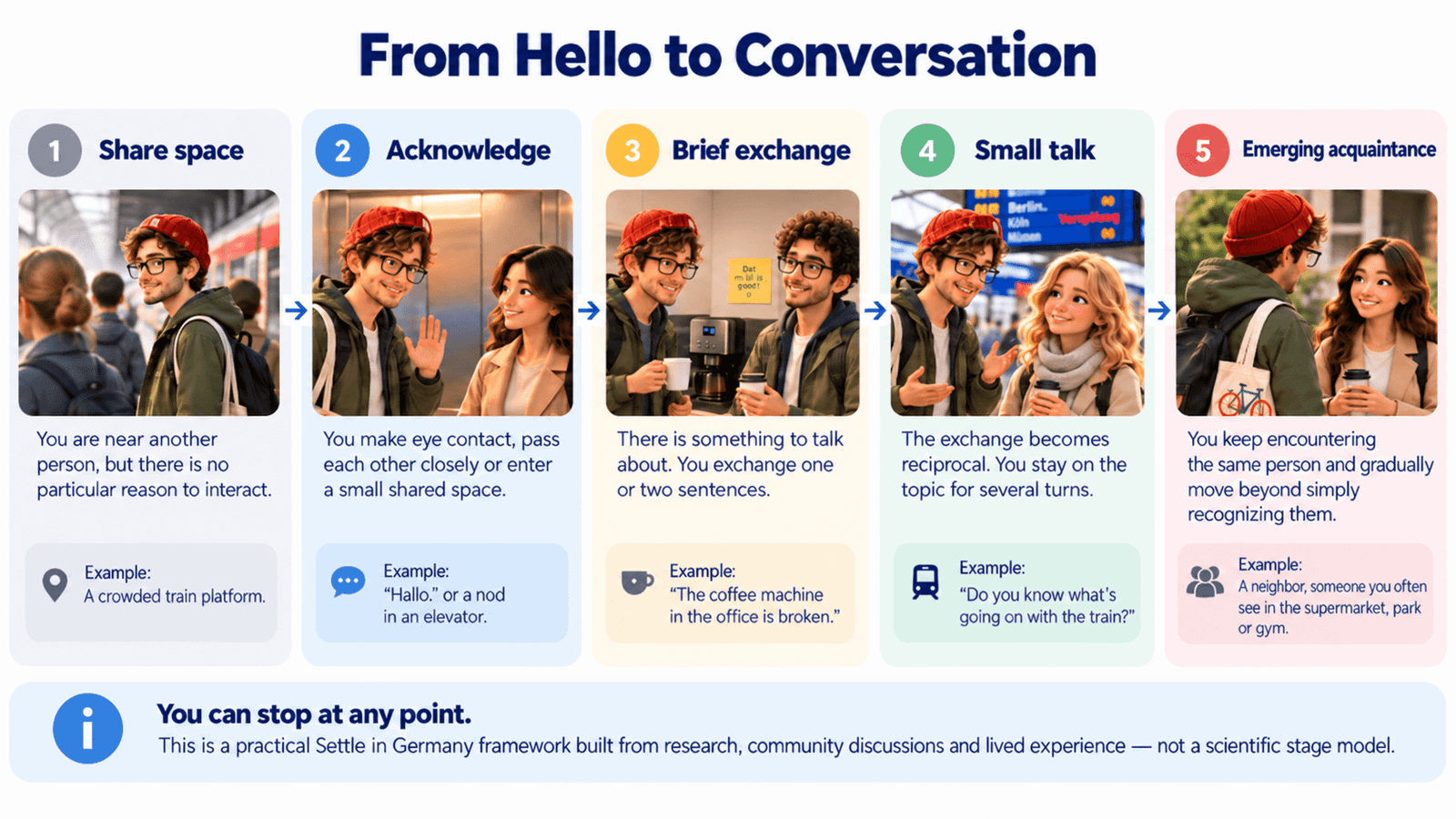
1. Share space
You are near another person, but there is no particular social opening.
Think of a crowded station, a busy shopping street, or a full train platform. No one has to acknowledge everyone around them. Doing nothing here is not the same as actively rejecting someone.
2. Acknowledge
Your eyes meet, you pass each other closely, you enter a small shared space, or you simply become mutually aware of each other.
The interaction might be nothing more than:
German: Hallo. / Morgen.
English: “Hi.” / “Morning.”
Or even just a nod.
Psychologists use the concept of civil inattention for a related phenomenon: briefly acknowledging another person and then withdrawing attention rather than inviting further interaction. A Germany-based study of civil inattention describes examples such as brief eye contact, a nod or smile followed by looking away.
The greeting is not an unsuccessful attempt at conversation. It is the interaction and should not be confused with the German stare.
3. Brief situational exchange
Now there is something to talk about.
The train is delayed. Your dogs have stopped to investigate each other. The office coffee machine is broken. Someone has a practical question. Something unusual just happened.
You exchange one or two sentences. And then you may stop.
4. Small talk
The exchange becomes reciprocal.
The other person adds something. They ask you a question back. You stay on the topic for several turns. A one-line comment has become a lightweight conversation.
It still does not have to become personal or long.
5. Emerging acquaintance
When building a home in Germany, you keep encountering the same person and gradually move beyond simply recognizing them.
That could be a neighbor you regularly meet in the hallway, someone you often see in the same supermarket, a person you repeatedly pass in the park, or somebody who tends to be at the gym at the same time as you.
At first, you might only recognize each other. Then you start greeting. Later, one of you makes a comment or asks something even though nothing unusual has happened.
The important shift is not simply seeing the same person repeatedly. It is growing recognition plus voluntary interaction beyond the immediate situation.
Eventually, you may talk without needing the original trigger, spend more time together, or start discussing things you actually care about. At that point, you are leaving the small-talk territory of this article and moving toward acquaintance and friendship.
The situation is often your best conversation starter
Many language guides begin by giving you topics: weather, hobbies, travel, sports. Those can work. But in many everyday interactions, an easier opener is simply whatever you’re both experiencing right now.
Research on how strangers initiate conversations on public trains in Germany found that a shared or visible focus of attention can create an opening, and examined transport disruptions as one context in which interaction among strangers can change.
That gives you a more useful principle than memorizing 25 conversation starters: Look for the shared situation first.
A delayed train:
German: Weißt du, was los ist?
English: Do you know what’s going on?
A very crowded train:
German: Ganz schön voll heute.
English: Pretty crowded today.
A broken coffee machine in the office:
German: Funktioniert die bei dir auch nicht?
English: Is it not working for you either?
When working with German colleagues, the shared context can be the office itself: a new piece of equipment, a process, something happening in the company, or what somebody is currently working on.
And yes, the conversation can happen entirely in English. You do not need German fluency to apply the same social judgment about whether this is a moment for acknowledgment, one sentence or a longer exchange.
Our review of public community discussions showed the same recurring pattern: delayed transport, weather, dogs, and other shared circumstances repeatedly appeared as natural openings. We used these discussions as qualitative signals, not as evidence of how frequently Germans behave this way.
So what do Germans actually talk about?
Usually, Germans don’t have a special set of small-talk topics. The more useful distinction is between context-linked conversation and topics you introduce without an obvious shared trigger.
In my experience, common lightweight conversations include:
- the train or bus you are both waiting for,
- weather you are both dealing with,
- something happening around you,
- dogs, children or another obvious shared situation,
- a football match or major event that has just happened,
- at work: current projects, office equipment, IT, processes or company news,
- in repeated settings: the activity itself, whether that is a class, sport or Verein.
The weather stereotype works for one simple reason: it gives two people an immediate shared subject without requiring either person to disclose much. But you do not need to restrict yourself to weather.
The important thing is that the topic fits the relationship and the moment.
With a stranger, a situation-linked comment is low commitment. With a colleague you know better, the conversation can range much further. With someone you’ve become acquainted with, you may not need a situational topic at all. This is why a universal list of “safe German topics” is less useful than it sounds.
Why silence can be completely normal
One thing that can feel strange after moving to Germany is that a social interaction may simply… not happen.
Nobody talks at the bus stop. Your elevator ride stays silent. A colleague answers briefly and returns to their screen. That doesn’t give you enough information to conclude the person dislikes you.
The German civil-inattention study is useful here because it treats limited interaction as social behavior in its own right: people can acknowledge one another while also signaling that communication will not continue. In its qualitative interviews, participants also described factors such as physical proximity and the number of people present as relevant to this type of public encounter.
At the same time, it would be dismissive to tell internationals that they are simply imagining every difference.
Cross-cultural pragmatics research comparing German and English communicative styles identifies differences in preferred communication patterns.
And in a 2026 qualitative study of 36 migrants in four German cities, participants described experiences the researchers grouped under social minimalism, including reserved interaction and limited small bonding behaviors. Because the study is qualitative, it cannot tell us how common this is across Germany.
So two things can be true:
- The interaction may genuinely feel sparse to you.
- That sparse interaction may not be a personal rejection.
Not sure what a specificinteraction meant?
Was that just a greeting, a polite exchange, or actual interest?
What small talk looks like in everyday Germany
No single rulebook works across every person, city, or situation. But some contexts make particular interaction levels more plausible than others.
The following table is deliberately probabilistic, and plausible is not the same as required.
| Situation | Plausible starting point | What you might do | Evidence level |
|---|---|---|---|
| Crowded city street | Share space | Nothing | Practical heuristic |
| Quiet residential street | Acknowledge | Nod, Hallo/Morgen if the moment arises | Community/experience |
| Elevator | Acknowledge | Brief greeting; silence afterwards is fine | Germany-based research/experience |
| Apartment hallway | Acknowledge / brief exchange | Greet; talk if there is a natural reason | Community/experience |
| Doctor’s waiting room | Acknowledge | A general Morgen/Guten Tag may fit | Recurring community signal |
| Hiking path | Acknowledge | Brief greeting is commonly reported | Community signal, not national rule |
| Dogs meet | Brief exchange | Comment or ask something about the dogs | Community/experience |
| Small owner-run shop | Brief exchange | Situational comment if conversation arises | Experience/community |
| Queue | Share space / brief exchange | Talk when something gives you a reason | Experience |
| Normal train journey | Share space | Silence is fine | Research/context |
| Delayed train | Brief exchange | Ask or comment about the delay | Germany-based train research |
| Office kitchen | Brief exchange / small talk | Work, coffee, setup, current company happenings | First-hand experience |
| Verein / regular class | Brief exchange / small talk | Repeated contact creates more opportunities | Community/experience |
Do people greet more in villages?
In a mixed-methods study covering 40 very rural German municipalities, 79.4% of surveyed residents said they hoped newcomers would greet them in the street.
That gives us reasonable evidence for stronger greeting expectations in at least some very rural German settings. It does not establish the opposite rule that people in cities do not greet.
Another factor may be how anonymous the situation feels. I notice this myself: if I pass one person on an otherwise empty residential street, saying hello can feel much more natural than when I pass hundreds of people in a city center.
That interpretation has some support: in the qualitative part of the civil-inattention study, nearly half of interview participants mentioned the number of people present as a contextual factor. The study did not test whether fewer people directly cause more greetings. So the useful takeaway is
- not: village = greet
- not: city = don’t greet.
- but: lower-anonymity situations can change what feels socially natural.
What about Cologne, Berlin and regional differences?
People often report regional differences in casual interaction, and in my own experience, Cologne feels more conversational than Berlin. But that is not enough for a reliable German regional ranking.
Treat region as one possible modifier — alongside the specific neighborhood, number of people around, repeated contact, and individual personality — rather than an instruction manual.
A strange but useful example: the waiting room
Here is a situation that shows why “Germans don’t greet strangers” is too simple.
In public community discussions, internationals repeatedly describe entering a doctor’s waiting room and encountering a general Morgen or Guten Tag directed at the room.
The interesting part is what happens next:
- You greet the room.
- The room may greet you back.
- Everyone returns to waiting.
This is a community-reported micro-norm, not a nationwide rule. But it is a useful example of why acknowledgment and small talk shouldn’t be treated the same.
What does Wie geht’s? actually mean?
Another popular rule says Germans only ask Wie geht’s? (How are you?) if they genuinely want a detailed answer. Reality appears more context-dependent.
In my experience, if I ask a friend, a closer acquaintance or a colleague Wie geht’s? while we are actually standing together talking, I expect a real answer.
But imagine I arrive at sports practice and greet five people one after another. If I ask someone how they are during that rapid greeting, I don’t expect a complete life update before I have even put my bag down. The same can apply to people you repeatedly see at work, sport, or another activity but barely know.
Public discussions show similarly contradictory expectations around this question, another reason not to make it a national rule.
A useful principle is: The closer the relationship — and the more conversational space the moment provides — the more room there is for a real answer.
Germans clearly do make small talk
I personally dislike meaningless small talk. I am also German. Unfortunately for the stereotype, I know plenty of Germans who can talk forever. That is a useful reminder:
Individual preference is not national behavior.
Contexts where casual conversation repeatedly appears in community accounts and in my own experience include market stalls and small shops, bars and nightlife, Biergärten, hiking, train journeys, neighbor encounters, Vereine, and other repeated activities.
The disagreement in community discussions is useful in itself. Some people describe German interaction as very reserved; others describe highly conversational settings. Both are better evidence for variation than either is for one national rule.
What to say — in German or English
You may be living in Germany without speaking much German yet. That does not make this section useless. The language may be English, but the social situation is still the same one you are navigating in Germany.
If you only want to acknowledge someone
German: Hallo.
English: Hi.
German: Morgen.
English: Morning.
Use these when the greeting itself is enough: elevator, hallway, quiet path, or another small shared space. You do not have to add a question.
If the situation gives you an opener
Useful when you are both dealing with the same disruption:
- German: Weißt du, was los ist?
- English: Do you know what’s going on?
More playful, tone matters:
- German: Kommt der Zug heute noch?
- English: Do you think this train is ever coming?
A comment rather than an interrogation:
- German: Ganz schön voll heute.
- English: Pretty crowded today.
The shared problem does the conversational work.
- German: Funktioniert die bei dir auch nicht?
- English: Is it not working for you either?
At work or in another repeated setting
Instead of inventing an unrelated topic, use what you already share.
- German: Wie läuft’s mit dem Projekt? / English: How’s the project going?
- German: Hast du das neue Setup schon ausprobiert? / English: Have you tried the new setup yet?
In my experience, office small talk often includes lightweight work-adjacent topics: what somebody is working on, the office, IT equipment, company processes, or whatever has just changed.
If you want to keep talking
The exact phrase matters less than the reciprocity:
- German: Und bei dir? / English: How about you?
- German: Echt? Wie kam’s dazu? / English: Really? How did that happen?
- German: Machst du das öfter? / English: Do you do that often?
How do you know whether to keep talking?
No reliable body-language code tells you another person’s intention. Instead, look for a pattern of reciprocity. Someone may be more open to continuing if they:
- give a substantive rather than minimal answer,
- ask something back,
- add new information,
- continue contributing to the shared topic,
- stay engaged instead of immediately returning to what they were doing.
A 2025 study of high-quality listening between strangers found that global listening behaviors were associated with markers of social connection in a small-talk condition. In the deeper-conversation condition, behaviors such as follow-up questions and verbal validation were also linked to connection. These are indicators, not a way to diagnose another person’s intent.
Most importantly, a short answer doesn’t mean rejection.
Maybe the person does not want to talk. Maybe they are tired. Maybe they are busy. Maybe they simply have nothing else to add. Look for the pattern, not one signal.
How to stop after two sentences
Starting a conversation can create another worry: Am I now trapped in it? You are not.
Our community review surfaced people who avoid opening conversations in settings such as long train rides because they worry that one opening creates an expectation to continue. Whether or not that worry is justified in any individual case, it highlights a useful skill that language guides often neglect: ending small talk.
A delayed train
German
— Weißt du, was los ist?
— Nein, leider nicht. Schon wieder Verspätung.
— Ja, typisch. Dann hoffe ich mal, dass er bald kommt.
— Ich auch.
Fertig.
English
— Do you know what’s going on?
— No, unfortunately. Delayed again.
— Yeah, typical. Hopefully it comes soon.
— Hopefully.
Done.
Leaving the interaction
German: Na dann, schönen Tag noch.
English: Anyway, have a good day.
German: Ich muss weiter — schönen Abend noch.
English: I have to get going — have a good evening.
German: Viel Erfolg noch!
English: Good luck with it!
There is no rude German behavior here.
When small talk becomes something more
Sometimes you simply keep seeing someone. A neighbor. A colleague. Someone you repeatedly see in the same supermarket, park or gym. Someone at sport or in your Verein.
At first, you may just recognize each other. Then you start greeting. Eventually, one of you says something even though no special event requires it.
In my experience, the interaction starts becoming something different when you no longer need the original situation to talk: you spend more time together, meet in another context, or start discussing things that genuinely interest you.
That is where a relationship intensifies, and you might start to make a friend in Germany.
The rule worth remembering
If you remember one thing, make it this. Do not ask first: What topic should I use? Ask: What level of interaction fits this moment?
- Are you simply sharing space?
- Did you acknowledge each other?
- Is there something obvious you both share?
- Is the other person contributing back?
Sometimes that leads to a conversation. Sometimes it leads to one sentence. And sometimes a quick Morgen is all that was supposed to happen. That is not bad small talk.
That is everyday social interaction doing exactly what it needed to do.
How we researched this article
We reviewed Germany-specific research on public encounters and stranger conversations, cross-cultural research on German and English communicative styles, qualitative research on migrants’ experiences in Germany, research on rural neighborhood expectations, and general conversation research on listening and social connection.
We also reviewed public community discussions to identify recurring situations, language, disagreements, and counterexamples. Those discussions were treated as qualitative signals, not as representative evidence of how often people in Germany behave in a certain way.
First-hand German experience was used to illustrate and interpret everyday situations, not to establish prevalence. The Share space → Acknowledge → Brief exchange → Small talk → Emerging acquaintance model is a Settle in Germany editorial synthesis designed to organize the evidence and help readers make practical decisions; it is not a validated scientific stage model.
What we did not find: representative evidence showing that Germans as a population hate small talk, a nationwide rule for greetings in settings such as elevators or hiking paths, or robust comparative data that would justify ranking German regions by how conversational they are.
See all sources
Scientific Research
- Diefenbach et al. (2024): Psychological needs related to civil inattention
- Pütz, O. (2018): How Strangers Initiate Conversations
- House, J. (2006): Communicative styles in English and German
- Duden et al. (2026): Inside-Out
- Glorius et al. (2020): Is Social Contact With the Resident Population a Prerequisite of Well-Being and Place Attachment?
- West et al. (2025): High-quality listening behaviors linked to social connection between strangers
Practical discovery sources
